Writing a book, memories

Worthwhile to click this photo

Sometime around 1988 my mother was diagnosed with small cell carcinoma of the lung, a type of lung cancer with few survivors. At the time she was living in the small house we built for her behind our house in days memorable for their sweetness with David playing at Grandmother Mary’s house standing on a little step stool (the stool is in my utility room 40 years later) at her kitchen sink playing in the water, helping her cook, just being there and all of us having dinner together several times/week, hanging out in the back yard, hanging out at my Mom’s and Leslie’s and my house where in the living room we had taken some of the furniture out to fit in a giant (~7x4x4) heavy cardboard refrigerator box I’d gotten behind Weir’s Furniture store and cut a little door in to fit 2-3-4 year old children and there was a window and a blanket on the floor

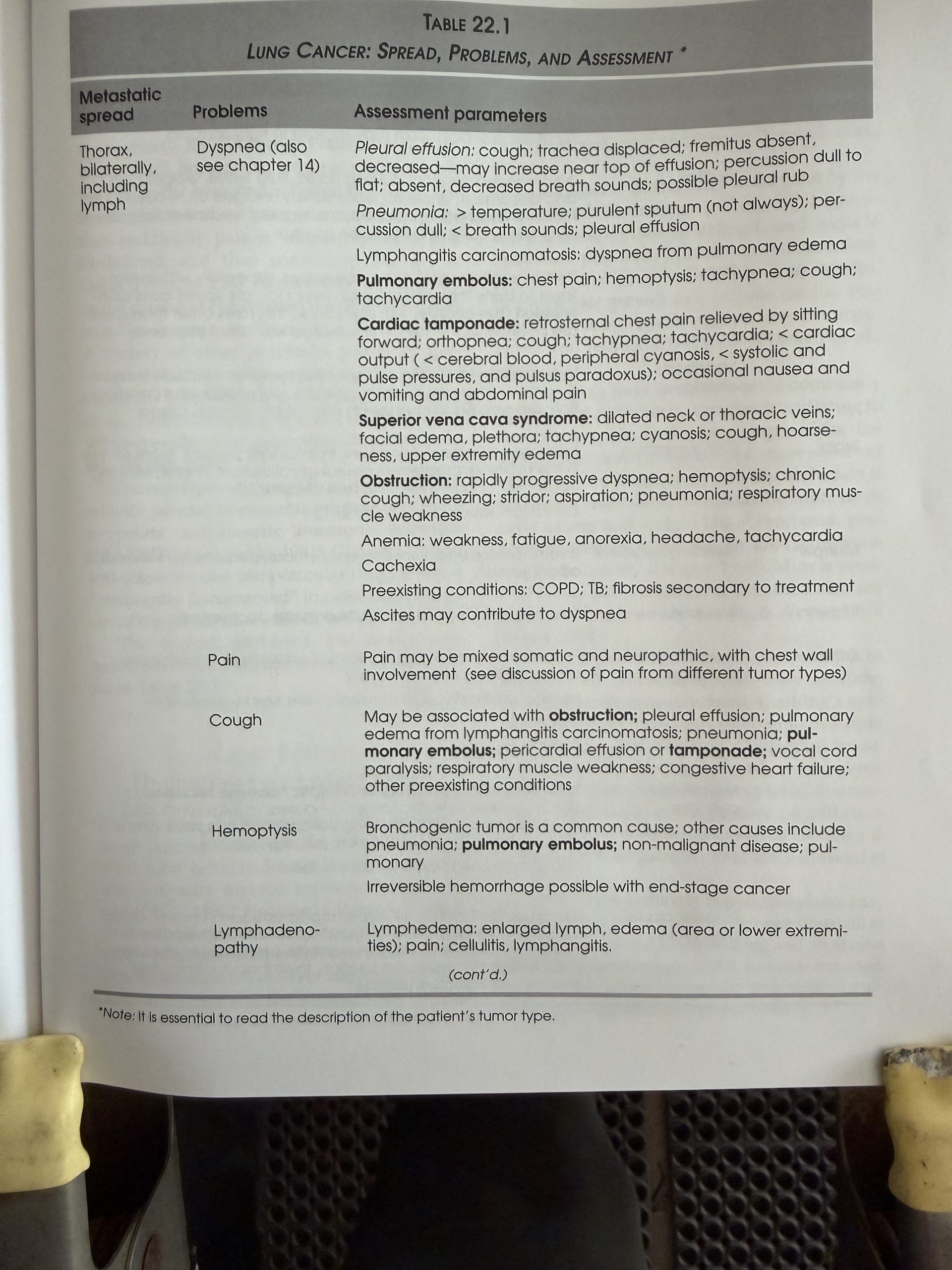
Lung cancer, natural history 1 (See multiple potential causes of difficulty breathing in lung cancer, some of which can be alleviated or even eliminated.)

inside and lots of pillows and stuffed animals – altogether a much better entertainment center than a TV! But back to my Mom and the book…

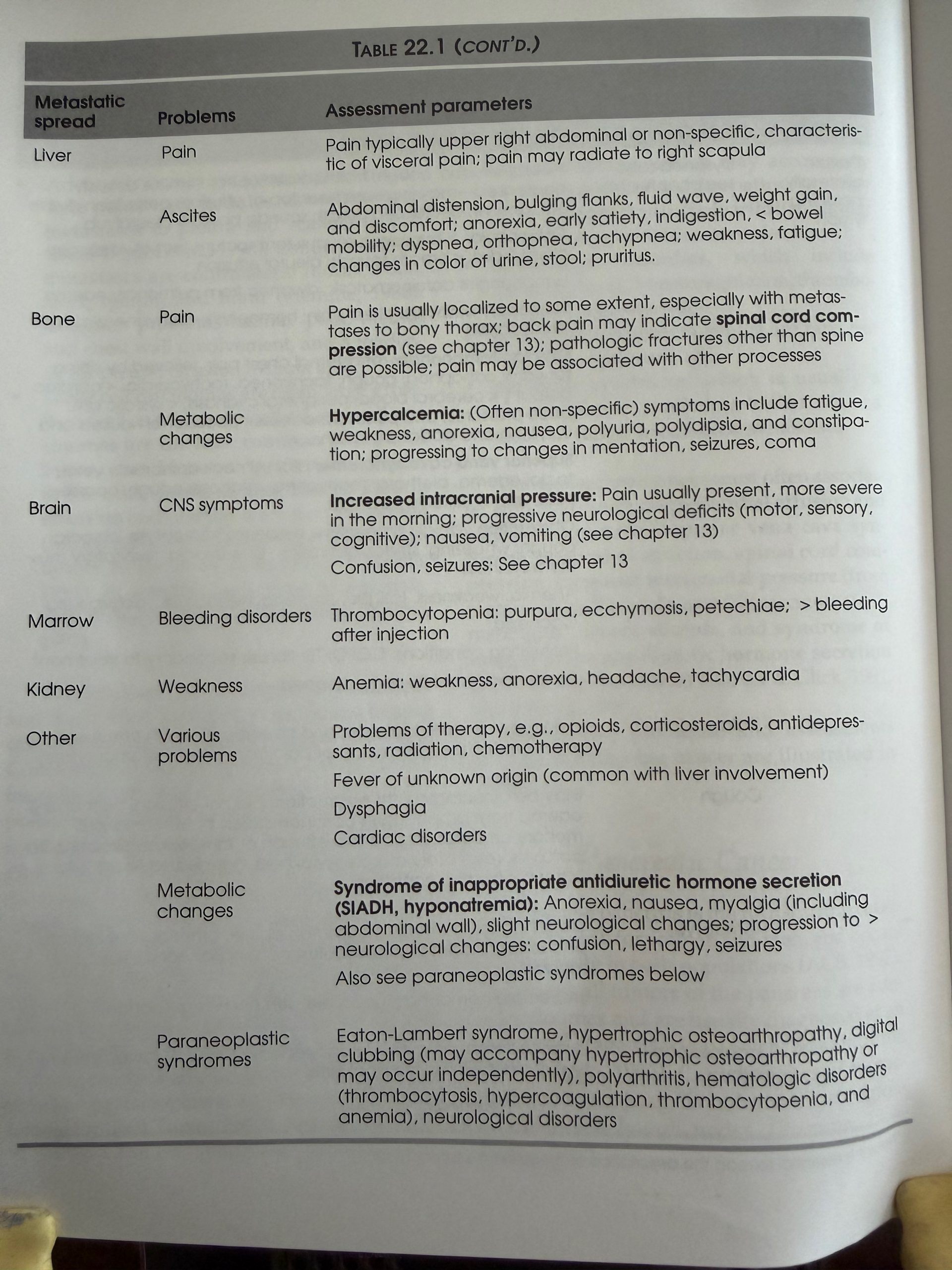
To her situation I brought some solid hospice experience, some good clinical skills and knowledge, some understanding of the end of life, and a commitment to take good care of my Mom. At the onset of all this I thought I would ramp up the care I would give by reaching a greater depth of understanding of lung cancer. My explorations evolved into a kind of chart that explicated what I thought of as the natural history of small cell carcinoma, including the most common sites of metastases, oncologic emergencies, and paraneoplastic syndromes. I consulted and clarified the chart throughout her illness and in at least one instance I was able to instantly identify and intervene in an oncology emergency (cord compression) before it became an emergency.

A few years after my Mom died (https://ckjournal.com/how-my-mom-died) I thought I would expand on what I’d done re the natural history of cancer. To that end I charted the natural histories of the 18 most lethal tumors leading to death in the US. Each tumor type was broken down into:

  • Primary tumor
  • Sites of metastases
  • Problems related to the primary tumor and metastases
  • Assessment parameters

(Later these tables were reproduced and further expanded in a series of articles in the American Journal of Hospice and Palliative Care.)

The tables anchored my book, Terminal Illness: A Guide to Nursing Care, published by J.B. Lippincott (1995, 1999). The book also explored individual and family responses to terminal illness, spiritual and cultural issues at the end of life, pain and other common physical problems, and diseases other than cancer encountered in hospice and palliative care. It took about two years to write.

Lung cancer, natural history 2

The reason for writing the book was to improve the care of people at the end of life. It was intended primarily for hospice nurses and others working in hospice and palliative care, who, in the course of one week might see patients with cancers of the lung, colon, pancreas, head and neck, and someone with end stage myasthenia gravis. And in the next week see patients with cancers of the esophagus, prostate, ovaries, and so on. That’s a challenge to provide quality care to people with so many different problems! The book was a tool for doing quality care at the end of life, a tool for practicing loving kindness.

For Absence

(A blessing for those who have left us and for we who are still here – the author is John O’Donohue) 

May you know that absence is alive with hidden presence, that nothing is ever lost or forgotten.

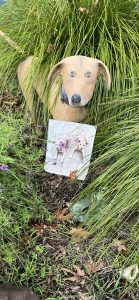
Not far from our home somebody made this sculpture/memorial for a good old dog who passed away. Good Boy!

May the absences in your life grow full of eternal echo.

May you sense around you the secret Elsewhere where the presences that have left you dwell.

May you be generous in your embrace of loss.

May the sore well of grief turn into a seamless flow of presence.

May your compassion reach out to the ones we never hear from.

May you have the courage to speak for the excluded ones.

Make you become the gracious and passionate subject of your own life.

May you not disrespect your mystery through brittle words or false belonging.

May you be embraced by God in whom dawn and twilight are one.

May your longing inhabit its dreams within the Great Belonging.

______

Jean gave me a book of blessings, To Bless the Space Between Us by John O’Donohue. We read from it most mornings and take great inspiration from the reading. It is a wonderful way to start the day – a blessing in itself.  

Biblical parallels with Alex Pretti’s death

“the executioner’s face is always well-hidden”

Once again, I see parallels between what is happening in Minnesota and the teachings of Christ. Alex Pretti’s last words — spoken to a woman whom an ICE agent had pushed to the frozen concrete — were, “Are you okay?”

Jesus said, “Blessed are the merciful.”

There are other parts of the Beatitudes that apply. When Alex addressed the agent who pushed the woman, he said, “Don’t touch her!”

Jesus said, “Blessed are those who hunger and thirst after righteousness.”

It is noteworthy that Alex was a nurse — an RN working in the VA intensive care unit. He died after being beaten by 5 or 6 ICE agents, while on his knees, unarmed, and shot multiple times in the back.

Jesus taught: “Blessed are those who are persecuted for righteousness’ sake.”

Exactly how we die isn’t the main thing; the main thing is how we live. His manner of dying was terrible and in no way blessed. But he and his life were a blessing.

The defining thing in Alex Pretti’s life seems to have been a commitment to practicing mercy. Thank you, Brother.

Make no mistake: Trump did it. ICE and the unspeakably vile Miller and Noem bear responsibility, but this is all on Trump. Resist!

Renee Good: Biblical parallels

Jesus said, “Forgive them for they know not what they do.” Luke 23:34
The soldiers went ahead and killed Jesus.

Renee said, ““That’s fine, dude. I’m not mad at you.”
The ICE agent killed Renee (and he videoed it!).

Renee Nicole Good Renee Good has long, blonde, curly hair and is wearing a red off-the-shoulder top. The ocean is in the background.

The soldiers played at dice for Jesus’ clothes
After he killed Renee, the agent said, “Fucking bitch.”

The agent’s father said, “He’s a committed, conservative Christian…”

Jesus wept.

Her name was Good.

Thoughts on life review at an advanced age

The final stage or conflict (or state of mind or life theme) in life is integrity vs. despair. As with so much else in a person’s life, these states of mind are not necessarily clear-cut. I think what we want to do is incline ourselves toward integrity vs. inclining toward despair or kind of drifting along with under-lying despair. How does that happen?

Andy’s Dream by Jean Cacicedo. Used with permission.

I believe it’s true that we’re generally doing the best we can under the circumstances. Most of us could sometimes do better, but still, looking back, not bad.

It’s not about accomplishments in the common use of that concept. For some people it’s a great, great accomplishment to be a half-way decent person – to not be abusive or mean. I mean, wouldn’t it be a beautiful world if everybody was non-abusive, not mean, not a cheater! So yes, good work, mate!

One way to move toward positive resolution (integrity or integration) is to deepen one’s life review. I say “deepen” because most people do think about their life, even when they try not to think about it. Too often we focus on negatives, losses, mistakes, failures, bad things beyond our control (like a hard childhood or poverty or death), and stay stuck on those parts or even pretend that they don’t exist. But they do. How does one get past failures or lacks in life? Here we go with one conception of the deepened life review.

(Life review is a psychological, emotional, social, and ultimately spiritual process of exploring one’s life past and present, how it unfolded, choices made, relationships, losses, patterns, themes, values, and other core dimensions of a life.)

One way to review in a holistic way is think about in detail 5-8 things in each of the below categories:

  • What is missing in life now (people, activities, abilities).
  • Wonderful things that have happened.
  • Regrets and mistakes and bad things that happened, including those we had no control over.
  • Hard times and getting through them.
  • Good moves/accomplishments.

Looking closely at these, we can see that there may much to grieve, there may be things that have wounded us, things that have wounded others, things that are hard to see and accept, things that were and were not our fault. It is my firm belief that going deep into the negatives is necessary to really see the positives – the beautiful things, the life accomplishments, the strengths, the beauty in not being mean.

Ahhh, the beautiful Wind Rivers

There are other life review processes. My focus is on words, but of course there are other means of expression such as art, music, and other ways of self-expression. Many include recommendations to do it as part formal group or with professional guidance. That’s not necessary. Google or ChatGPT will yield several structures for doing one’s own life review.

Life review processes or techniques include:

  • Mapping time, e.g., a history of life (key events, motivators, people, emotions, decisions, stressors, etc.)
  • Taking a deep dive into turning points and thresholds (what was life like before and after and after the change, what inner and outer resources were involved, what was left behind and gained, and what issues still linger).
  • Writing letters to my younger self at three specific ages/turning points.
  • Writing four to five “stories that made me who I am today,” including lessons learned.
  • These are directed toward integration vs. nostalgia.

It is a worthy thing to do is write one’s obituary, eulogy, or things you would like to be remembered for after you die.

6 am

This is written with the idea that some readers might consider this for themselves. Any age is a good time to do it. Old age is an especially good time to do it.

Background: Based on experience and other explorations of life and death I developed training for staff in the first hospice in Texas. Training included values clarification and life review for everyone who would be working in hospice (originally called the “obituary exercise”). The idea was to increase self-awareness and thus increase understanding and empathy around this major life event – the end of a life. Every training, class, or workshop included a lot of content on the practicalities of physical care at the end of life. Variations on the initial training continued in the original hospice, other hospice programs, workshops, and into undergraduate and graduate courses on the end of life. I also taught values clarification and life review as tools to use in working with patients and families facing the end of life.

We were at a friend’s home, talking. My friend said, “I haven’t really accomplished much in life.” I looked around and thought, “What a beautiful home and life you’ve created. Actually (I thought) you’re a truly beautiful person.”

Life review – thoughts

I began listing a few things I miss in my life now. I tried to limit it to 5-8 things. That led to consideration of beautiful times, which led to…

Things I miss

  • Leslie.
  • Backpacking in the wilderness.
  • Being a part of the global underground, especially trance gatherings in the forest.
  • Related to the above, DMT, MDMA, LSD/psychedelics, smoking cannabis.
  • Smoking cigarettes.
  • Of course I miss being strong, quick, pain-free, all that kind of thing.
  • I don’t miss work, though if I was younger and stronger I would certainly be deeply invested in working as I once did. I just don’t have much strive left. I feel that I did the best I could – I left it all on the field.
  • Gardening.
  • Sunday mornings with David, like at the rail yard; having lunch every week with David in California.
  • Flying across the mighty Pacific in a 747 on the way to or from another two-month trip to Asia.

Some beautiful times

  • Being in the chow hall they had set up for the sole use of Marines returning from Vietnam and I was eating chocolate cake and drinking cold milk (as much as I wanted!) and listening to Groovin’ by Young Rascals on the jukebox. I was alive!
  • Getting to the bottom of a >1000 foot glissade down Twins Glacier in the Wind River mountains past the crux of a great trek and it was my 65th birthday!
  • Sitting in the kitchen with Jeff in the apartment on Oram (so homey, walls with a little sideways slant, painted yellow), coming on to Orange Sunshine. Truly, truly, everything was perfect.
  • Marrying and being married to Leslie.
  • Being in Burma, being exactly where Supilawyet sat “By the old Moulmein Pagoda, lookin’ lazy at the sea…” In Kathmandu, Bangkok, Saigon, Sapa, Hue, Granada, Santa Fe, Mendocino, Berkeley, all those places!
  • Being on a 747 coming home after two months in Asia at the perfect intersection of the perfect trip and going home.
  • Being married to Jean, living in Berkeley, living in Northern California!
  • My work (hospice, refugees, teaching, scholarship, serving, being part of the good).
  • Sooo many mornings lying in bed, having coffee together, talking…

Mistakes and regrets

  • Being a fuck-up in elementary and high school.
  • Smoking cigarettes.
  • Saying stupid things (multiple instances).
  • Wasted time, especially related to anger.
  • Never getting straight with my father – I’m not talking about forgiveness; it’s something else, but I’m not sure what.

Hard times

  • The war in Vietnam, especially the Hill Fights
  • When Leslie was sick and after she died.
  • Much of my childhood and teen years.

Good moves/accomplishments

  • Learning to be a good parent – Thanks, Leslie!
  • Being (for the most part) a good husband to Leslie and Jean and for the most part, a good Dad to David.
  • Becoming a nurse.
  • All the scholarship (books, articles, papers).
  • Hospice and refugee work, Agape; learning how different people live; being part of so many lives.
  • LSD, MDMA, psytrance.
  • Starting back to Backpacking in my 60s; dropping back into the global underground also in my 60s.
  • Staying true to the vision for the last 60 years of my life.
  • Taking good care of my mother and of Leslie at the end of their lives.

Eulogy

Eulogy, Charles Kemp

(10-minute reading, so relax)

Born August 30, 1944, in Tyler, Texas. Died ______________ in Berkeley, California. His greatest achievement in life was overcoming the karma of a difficult childhood and becoming a decent man, husband, and father.

He dropped out of high school in his senior year and spent a year and a half as a “climbing bum,” rock-climbing and hitch-hiking around Colorado and Wyoming, and working as a short-order and dinner cook. After returning to Dallas he completed high school, then returned west to climb. He started college but dropped out and joined the Marines in 1965.

After eight months of training, he was sent to Vietnam as an infantryman in the 26th Marine Regiment Special Landing Force. He saw heavy combat throughout his 13-month tour of duty near the DMZ but was only slightly wounded. He was proud to have fought in both the 26th Marines and 9th Marines in Operation Deckhouse (IV and V), Operation Prairie, the Hill Fights, Con Thien, Dodge City, and other engagements. Decorations included the Purple Heart, Combat Action Ribbon, Presidential Unit Citation, Navy Unit Commendation, and others. He learned that life is a gift. His entire life he was grateful to be alive.

He returned home in 1967 and attended college for a few semesters, but much of 1967-1972 was spent integrating the experience of the war with civilian life. He married his high school sweetheart, Leslie, in 1969. They had met outside the cafeteria at Thomas Jefferson High School when they were 16 – it was love at first sight and it endured. They were married 45 years. His healing came through Leslie, LSD, and the personal strengths he carried within. In 1972, he returned to school and graduated magna cum laude in 1975 from Baylor University School of Nursing. After working in community health for several years he entered graduate school in 1977 at the University of Texas at Austin, earning a master’s degree in psychiatric nursing.

In 1978, he founded the first hospice in Texas, the Visiting Nurse Association Home Hospice, serving as its director and hospice clinical specialist. Under his leadership the VNA Home Hospice had the largest daily census in the US and became a National Hospice Demonstration Project. He worked with people at the end of life for most of the rest of his life.

He taught at Texas Woman’s University and Baylor University, where he led courses in end-of-life care, psychiatric nursing, and community health nursing. Under his guidance in clinical settings, students took on expanded service-learning roles in planning and delivering health services in underserved refugee communities. In 2000, he completed the family nurse practitioner program at Baylor. He worked as an FNP at the Agape Clinic serving mainly immigrants and refugees for the rest of his career.

Hospice care, refugee health, community health, and primary care were the primary focuses of his career. Most of his professional work centered on building and sustaining collective efforts involving multiple individuals and entities. Throughout his life he was committed to doing and teaching compassion. He authored three books, over 70 articles in professional journals, and numerous papers.

In addition to hospice work, he had sole or primary responsibility for planning, implementing, and/or securing funding for the below.

  • District health services through Baylor School of Nursing and community agencies serving refugees
  • Expansion of the Agape Clinic
  • Vietnam Veterans Resource Center (later part of the VA VSO service)
  • The East Dallas Health Coalition, a community-oriented primary care clinic now open seven days a week with multiple adult and pediatric services

These and other services benefitted thousands of people. Most are still in operation today.

In addition to his Marine Corps decorations, awards included inclusion in the Great 150 Baylor graduates over the 150 years of Baylor’s history, Fellow of the American Academy Nursing (national), the Abner V. McCall Humanitarian Award (Baylor University), Faculty Award for Excellence from Elsevier Science (national award), Outstanding University Scholar at Baylor, Outstanding University Lecturer at Baylor, Margaret Stein Award for Outstanding Service in Community Health (national), Presidential Citation Vietnam Veterans of America (national), Outstanding Volunteer from Dallas Volunteer Center/ARCO, J.C. Penney Golden Rule Award, and other awards from the Dallas Police, DFW Vietnamese Community, DISD, State of Texas, Presbyterian Church, and others.

He was a serious baker, gardener, and rosarian. He was a backpacker with numerous treks in Wyoming and Colorado, culminating in a 10-day trip deep in the Wind River Wilderness to celebrate his 65th birthday. In his 60s, he reconnected with his hippie roots through involvement in the psychedelic trance scene. He (re)learned to dance in these underground forest parties and led workshops on the end of life and psychedelic therapy at gatherings in Texas, Colorado, and New Mexico.

He and Leslie adopted their son, David, at birth, and took great joy in “our little family.” David was a good and faithful son to Leslie and Charles. Charles and Leslie worked closely together in the Cambodian refugee community and at the Agape Clinic. From the time David was a baby riding on Charles’ shoulders to now David has been involved in these efforts to serve the poor and for justice. They found happiness in their simple family life, their home, and in working and traveling together. Leslie died in 2015, and Charles cared for her during her final months. They had been married for 45 years.

Written in the beautiful city of Hue in Central Vietnam in 2012: We went to the Thien Mu Pagoda, 45 minutes up the perfume river from Hue. This where the monk Thich Quang Duc lived before he went to Saigon in 1966 to immolate himself in protest against the VN government and the war. The pagoda and grounds were quietly beautiful – understated and mossy with just a few people around and a view from the grounds across the wide river, past the plains, to these mist-covered mountains where we fought and bled, where so many from every side fought and bled and died, aching for life – me for a beautiful dark-haired girl whose photo was so washed out from the constant slogging through rain and padi water that only the shadow of her left eye was left and now, 45 years later, looking across the room from where I write she’s sitting on the bed, the love of my life, beautiful, her hair white now and here we are in Hue and I look out through the glass-paned doors through the mist toward palm trees and mossy buildings.

In 2021, after living together for five years, he married the artist Jean Cacicedo. Together they enjoyed an “endless summer” (that lasted more than two years), the magic of Berkeley, countless intimate days, and the fullest life imaginable. They traveled all over California, Colorado, Montana, and Wyoming, and in Asia and Europe. They prepared numerous meals together, endured health challenges, got through the pandemic together, and they lived happily ever after in Paradise (Berkeley).

He was fulfilled in every respect.

He is survived by his son, David Kemp; his wife, Jean Cacicedo; and his brother, John Kemp.

The reason why

After I came home from the war, I experienced visions—glimpses of a deeper reality, including the realization that we are all One. One outcome of those visions was my decision to take the Bodhisattva vow: to liberate all sentient beings. That vow, and the visions that preceded it, became guiding forces in my life. They made it possible for me to hear—and to answer—a calling to become a nurse.

I returned to school for three years, then began work as a registered nurse, later becoming a leader, educator, and, after further training, a family nurse practitioner (FNP). My career carried me through community health, hospice care, and, in its final twelve years, primary care. Whether working in hospice or with refugees and immigrants, my focus remained constant: to reduce and relieve suffering. I was inspired by Leslie and for many years worked in partnership with her.

Omayra Sanchez. Photo by Frank Fournier

In hospice care, this meant addressing pain, loneliness, fear, advanced illness, family distress, and a host of other challenges. In refugee health, it meant responding to trauma, cultural and personal isolation, poverty, illness, loss, and more. In education, the goals were to help students grasp foundational principles, cultivate responsibility, strive for competence, realize their potential, and embody compassion—along with other essential aspects of caring.

As part of a broader effort to inform and support others working to reduce suffering—and thereby contribute to the collective movement toward liberation—I wrote numerous articles, papers, and chapters, and authored or co-authored three books:

Terminal Illness: A Guide to Nursing Care (1995, 1999, Lippincott)
This book explores the individual, familial, cultural, and spiritual dimensions of the end-of-life experience. It offers practical guidance on managing symptoms such as pain, dyspnea, and nausea, and includes a detailed section outlining the natural progression and metastasis patterns of the 16 most lethal cancers—enabling clinicians to anticipate complications and intervene more effectively.

Refugee and Immigrant Health, with Lance Rasbridge (2004, Cambridge University Press)
The first section addresses the refugee experience—including physical and mental health, spiritual and religious influences, women’s health, and cultural frameworks. The second section profiles 31 cultural groups frequently seen in refugee and immigrant care, including Afghan, Cambodian, Haitian, and Mexican populations.

Leslie taking care of business behind the apartments at 4400 San Jacinto

Infectious and Tropical Diseases, with Tao Sheng Kwan-Gett and Carrie Kovarik (2006, Elsevier Science)
Written for primary care providers, missionaries, and refugee health workers, this compact guide opens with an overview of infectious and tropical diseases, followed by 647 pages covering over 90 conditions—from cholera and malaria to lice infestation and schistosomiasis. The final section helps clinicians link symptoms to geographic regions and likely diagnoses. Designed for fast settings, the book fits in a lab coat pocket and features a soft, durable binding.

Looking back now, at these books and the work in hospice and among refugees – the progression of the work and books and their intent, from the first sentences to the last – I see that I did do my best to live out that early vision of Oneness, to relieve suffering, and to honor the vow for Liberation.

I also remember that there were times when nothing could be done about the suffering and all that was left to do was to bear witness – “My soul is deeply grieved, to the point of death; remain here and watch with Me.”

Dreams to remember

1.

I awoke in a dream feeling incredibly good. Better than no pain; feeling literally incredibly good through my mind and entire body. I thought I must be dying. What do I do now? I said the Lord’s Prayer. Then I started over in the prayer and drifted back into unconsciousness.

2.

We were talking about what we were trying to do. Leslie was working on increasing quality and decreasing suffering – what makes us (patients and providers in the healthcare system) do better. I was thinking about the complexities of the interactions of people with the system. “If anyone can make it better it’s you,” I said to her. I was thinking about what a thing it is to do this work on the bodhisattva road.

Amen

Not that far from Desolation Row

Shotgun house. He lived with a prostitute in the front room of a shotgun house off Woodall-Rogers Freeway near downtown. (A shotgun house is a narrow one-story shack that could theoretically be cleared with one shotgun blast through the front door.) In the course of being treated for cancer he suffered a radiation injury that caused triplegia, paralysis of both legs and one arm. The other arm wasn’t much good. When he came home from the hospital the woman put him on a bedpan and left him there for a day or two. When I got there the skin over his coccyx was intact, but was kind of purplish. Within a few days the skin began to change color and underlying tissue began to break down and soon there was a large (~10 inches in diameter) and growing decubitus ulcer (down to the bone). I would clean the ulcer and we would talk. He was bitter about what had happened with the cancer treatment as I recall, but he had been a hard life before the illness and injury and he was mostly accepting or resigned, or so it seemed to me.

From time to time when I was there, the woman would bring a trick through his room on the way to her room. She was a heavy drinker and often smelled of liquor. She was sweet-natured and pretty in her own way, and I liked her. Teaching her to care for him was a real challenge.

The ulcer got bigger and bigger and after a few months he died. A couple of years later I saw the woman on a corner in another part of town and stopped to talk with her. She was drunk and smelled pretty strong. She asked me if I wanted to have sex with her, but I said no thank you and gave her some money. That was the last time I saw her.

———————-

Eggnog. He lived alone in the Cedar Springs projects. He had head and neck cancer (squamous cell carcinoma) with many tumors in the nodes of his neck and down into his chest. He had a mattress on his living room floor and he got around by crawling from one room to another. He had difficulty swallowing and was unable to take any solid food. He liked eggnog, which was fine around Christmas, but problematic after the holidays. I went to quite a few stores to find the last of the eggnog. After that he had to make do with protein drinks, which at the time were not as readily available as they are now.

———————

Burned. There had been a gas shortage and two brothers decided to hoard cans of gas to sell at a big profit. He lit a cigarette and the gas exploded, burning him over most of his body. After months in the Parkland burn unit he was finally discharged. He didn’t do his exercises and ended up with his arms frozen in a flexed position. He had no fingers, no nose, no ears – every part of his body that protruded had been burned off. He was pretty much all scar tissue.

He lived alone the same Cedar Springs projects as the man with head and neck cancer. His wife would come over sometimes and would throw his meals-on-wheels food on the floor. When he walked he would stagger; when he went out the children in the projects would throw things at him and call him names.

I don’t know what happened to him.

———————

A prayer. The promotora de salud (lay health promoter) and I went to see a woman with far-advanced cancer. She was in a coma and had gangrene. She lived in one of those barren outlying Oak Cliff pink brick apartment buildings where gangs pretty much ruled. The main thing we were there for was for the promotora to pray for the patient. We were there at her bedside – the patient and her daughter, the promotora, and me, all holding hands. Everything was in Spanish, except when the promotora leaned over to me and whispered, “I think her toe just fell off.” It had.

——————–

Dressing change. There was a homeless man who hung around on Bryan Street. One of his legs had an old injury that was chronically infected. The lower part of the leg was markedly enlarged and hard and suppurating. He refused to go to Parkland, the county hospital.

At the time, my students and I were operating out of the “police storefront” at the corner of Bryan and Annex. The police had banned the homeless man from coming inside after he had used their toilet to have a huge and hugely malodorous bowel movement.

He would come to the storefront every week and one of the students or I would change the dressing on that leg. It was literally a weekly dressing change that involved cutting away the old exudate and blood-soaked dressing and putting on a new dressing. He would sit on the bench of the picnic table or a retaining wall outside the storefront for someone to change the dressing. I thought the maggots might be what was keeping him alive. I was surprised at how fast maggots can move.

———————-

Staying home. Ms. Brown lived in a sparse one-bedroom apartment with Mr. Escalera. She had rheumatoid arthritis, was home-bound, and in fact, mostly bed-bound. I recall that the first time the students and I turned her over a multitude of cockroaches scattered out from under her back. She had several health problems, especially the pain from RA. She was a nice woman with a good spirit and was very strong mentally. While the students were in the bedroom with Ms. Brown, Mr. Escalera and I would sit at their little kitchen table, talking and him smoking. I marveled at how he was able to keep her at home – get her to the bathroom, take care of food, clean the apartment, everything. After a few years there were changes made in where and how the students and I were operating, and we quit seeing Ms. Brown. Ultimately, she developed cancer. She never told anyone and she just wasted away in her bed. I saw her a few times during the course of the illness, but she refused any assistance other than the home visits. My friend, Alison, the missionary also became involved. We all did exactly what Ms. Brown wanted, which was to help her never leave her home in her little apartment.

——————-

The students. When I refer to “the students” I mean the Baylor students who were in my community health clinical groups. Each semester I had two groups of eight students. Very few of them had ever been exposed to the levels of poverty and unmet health needs they were immersed in through  this work in refugee communities. They worked with me as partners in learning about community health through providing community health services. The students operated in two-person teams in designated neighborhoods. They learned about community health through finding people with problems and alongside the patients, solving the problems – and never just referring people to somewhere else.

As much as possible, they went through “the healthcare system” with patients; students learning, for example what the Parkland OB clinics are like: a waiting room with 50-100 plastic chairs; waiting room floor sticky with spilled soft drinks and baby formula, Cheetos, whatever; maybe 16 exam rooms around the waiting room (my memory is clouded re some details); someone shouting/mispronouncing patient names (you better not miss hearing your name called); and once in the exam room, being seen by a different person on every appointment (expect another vaginal exam); being sent out from exam not having any idea what next.

Eventually, as we developed the Agape Clinic (a-ga-pe) as a community resource, the students spent more and more time in the clinic, though we never abandoned the home visits and community outreach. In the clinic students had responsibilities that rotated week to week – triage, manager, exam rooms (5), pharmacy. As was the case with the outreach/home visits/district health model, students had significant responsibility and autonomy. Oh, what a job they did!

Here is a description of the work, in the streets https://ckjournal.com/in-the-streets and more on the Agape Clinic https://ckjournal.com/agape-clinic-recollections

——————–

On San Jacinto. In one of the apartment buildings in the 4000 block of San Jacinto there was a Vietnamese woman who had some unspecified mental health problems that were manifested in part by her yelling and sometimes fighting with neighbors. She had a dream one night that her apartment was filled with Buddhist and Catholic religious statues. She began putting religious statues in her apartment according to the dream and as the apartment was filled, she quit the yelling and fighting. She became something like a fortune-teller. Although she didn’t have any outstanding health needs, I would stop in at her apartment when I could. She would fix coffee for the two of us and we would sit at her kitchen table and talk.

In the same building there was an old Vietnamese couple living with a teenage girl named Thuy who was deaf and mute. The man had a stroke. He survived but was completely incapacitated. By some miracle he ended up in a nursing home just a mile or so from the apartment. His wife would walk to the facility every day to bathe and feed him. When he died the funeral service was held in a South Dallas funeral home. I remember his wife and Thuy ended up on their knees on the floor in front of the coffin, wailing and falling out. After school Thuy went to work at Fiesta groceries and did well, as far as I could tell.

In the same building there was a Cambodian woman who was married to a White man who was somehow involved in drugs. One day Leslie called me and said I should come to her office right away. When I got there the Cambodian woman was sitting under the conference table in Leslie’s office. She had appalling stitched lacerations on her body. Two men had come into the apartment and stabbed her husband to death, raped her, and slashed her. She had been taken to the ER and when they were done with her, a missionary named Chuck brought her to Leslie’s office. I went to her apartment to let the police know where she was. I remember how polite the homicide detective was when he questioned me (everyone is a suspect in their world). I remember that there was an amazing amount of blood on the bed, floor, walls, and even the ceiling.

In the same building there was a Lao family – three generations in a small apartment. They had pigeon cages covering several windows with the pigeons free to come and go to the outside world and a sliding door on the inside. At night whenever someone wanted they could open the sliding door and reach into the cage – pigeon for dinner. Eggs, too. The same family had a big aquarium filled with popcorn and big grubs eating the popcorn – grubs for dinner.

Across the street a widow with two sons lived in an upstairs apartment. One day the brothers were arguing over a bowl of rice. One of them stabbed the other, who fell out the window and died.

——————

Get-away. The students ran across a 16 year-old girl who was living with a man in his mother’s second-story apartment on Virginia Street. The girl wanted to leave, but the boyfriend and his mother wouldn’t let her. The students talked with the police, but they had already been in contact with the girl and she was uncooperative. Now, she said, she had to get out. The police wouldn’t help, so the students and I came up with a plan for the students to make a home visit and distract the mother. While that was happening in the living room, the girl was throwing her possessions (in three black plastic trash sacks) out the window to me waiting down below in my blue Toyota pick-up in the driveway between two apartment buildings. The girl then walked out of the room she shared with her boyfriend and followed by the students, walked out of the apartment to the alley where I was waiting. Away we all went to the police office. One of the police officers bought the girl a bus ticket to LA where she had family in Compton. She was back with the boyfriend in about a month.

——————

A man with a gun. In one of the apartments on Annex Street a Chinese woman from Vietnam ran a little store out of her apartment. People could buy soft drinks, snacks, and the like. One of her daughters had a large nevus (mole) on her face. The mother told her daughter the reason she had it was because in a previous life she had wasted her husband’s money. A dermatologist at Children’s Medical Center Girl decided it was appropriate to remove it surgically.

On the day of surgery I went to the apartment to drive the girl and her mother to CMC. The girl got in the truck first and said, “My mother says there’s a man with a gun in our building.” I said, “Tell her to get in the truck now.” The girl said, “There’s the man.” Sure enough a man was walking towards us and he had a pistol (like a .357) stuck in his jeans. I reached across the girl and pulled her mother into the truck and was backing up across chunks of concrete and curbs and whatever. Meanwhile, a man in a white car picked up the man with the gun. I drove around the block to the police storefront and told them about the man and several of them took off toward the apartment. We went on to CMC, where preoperatively they gave the girl a fentanyl sucker which pretty quickly got her all smiley and goofy. The surgery went well. The guy with the gun got away but an hour or so later got into a gunfight with the police on Central Expressway.