I found this document by accident in a random place on my computer. Reading this over now I am struck by how religious I was when I was writing then. I recall that almost everyone I knew who was involved in refugee health at the street or community level was religious or seriously humanist. We were all doing the best we could.
————————
These are dedicated with gratitude to our volunteers – without whom the clinic and mission could not happen. Some dates are inexact. Last update 5/2005
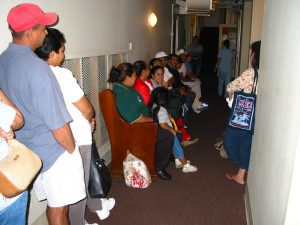
Waiting for clinic to open
Witness: Every Wednesday at Zaragoza Elementary school we hold parent education classes in the front of the school cafeteria. Every week during those classes the school brings in special needs students to the back of the cafeteria for breakfast. By special needs, I mean those with Down syndrome and other such problems. Week after week, month after month, and now, year after year these children are a witness. What witness?
- Of the children themselves, setting out on a long and difficult journey, of which they have no knowledge and few resources … the girl in the wheelchair, a beautiful and haunting sight; the boy who struggles with his walker and his limitations; the girl with Down syndrome whose laugh sounds so normal; the tall thin girl, kind of staggering and lost …
- Of the caregivers and teachers who, with consistent (and unsentimental) kindness, care for children who at times are not easy to care for and in so many ways are disconnected.
- Of the parents, bringing their tragic children to this school, this place of Hope … last week, a big handsome man, waving and smiling with love at his darling girl with Down syndrome.
- Of a society that tries to care for the least of these.
So, here’s to you, children, caregivers, parents, and school (and the society it represents and teaches). Thank you for showing me this love and beauty. Last week, right before we left Zaragoza, Cesar Termulo, a fine young doctor who gave the class that week said to me, “Right now, prayer is of utmost importance.”
Trust in Him at all times, O people; pour out your hearts before Him; God is a refuge for us. Psalm 62:8
Blessed are the poor in spirit, for theirs is the kingdom of heaven. Blessed are those who mourn, for they shall be comforted. Blessed are the meek, for they shall inherit the earth. Blessed are those who hunger and thirst for righteousness, for they shall be satisfied. Blessed are the merciful, for they shall obtain mercy. Blessed are the pure in heart, for they shall see God. Matthew 5:3-8
Take heart daughter; your faith has made you well … Matthew 9:22
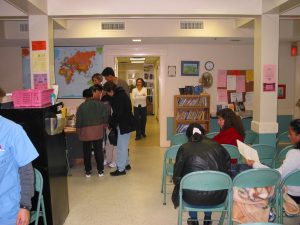
Waiting room
Amen (10/2004)
Going back to the question of eternal things … this is written by Lindsey, a high school student who is one of the Agape volunteers: Three friends and I stayed at, and worked in, the Long Yan Orphanage with the 17 special needs kids. They ranged in age from 4 to 18, and there were only 2 Chinese nannies per 12 hour shift to watch over them. Most of the kids didn’t have names. We gave them each a name that seemed to fit – Jason, Isaac, Daniel, even Bo. I will tell you about one of the 17 who won our hearts; we named her Annie. She thirteen years old, but was unable speak, sit up, or move from her wooden pallet. She was painfully thin and always restless.
We thought she was severely retarded and unable to understand us, but still we sat with her and talked to her, just to pass time. One afternoon after we’d been there about a week, Jessa, my good friend who lives in China and speaks Chinese fluently, was sitting with Annie just talking to her. As she switched from English to Chinese, she saw Annie become very alert, looking up at her with her brown eyes. She asked, “Annie, can you understand me? If you can understand me, open your mouth.” Slowly, Annie did so.
After that, she and Jessa worked out a system of communication and Jessa could get Annie things she specifically wanted. And every day, Jessa told Annie about Jesus.
The last day we were there, Jessa was sharing the gospel with Annie again. She decided to ask Annie if she wanted to pray and receive Christ. When she asked her if she wanted to, Annie opened her mouth- her way of saying yes. Jessa led her through a simple prayer and when she said, “Please forgive my sins and come into my life.” Annie began crying and crying. After a time, she calmed down and was filled with a peace I had never seen in her before. Jessa told her, “Annie, you’re my sister now. I’ll see you in heaven!” Annie looked up at her and squeezed her hand really hard.
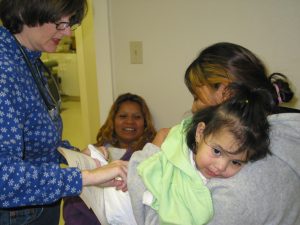
Bobbie Baxter, MD, Agape founder and medical director
After I got home, I learned that Annie died three days after we left the orphanage.
Meeting Annie changed my life. I can’t wait to see her again in heaven. All the orphans taught me more about God’s heart. Since I’ve been home, I’ve found so many verses in Scripture about how He cares for the helpless, for the fatherless. One of my favorites is Psalm 10:17-18, “You hear, O LORD, the desire of the afflicted; you encourage them, and you listen to their cry, defending the fatherless and the oppressed.”
(I know Jessa & Lindsey will take no credit for what happened, but I want to note that however it happened, they heard, encouraged, and defended the afflicted with hope where there was no hope.)
Grace: At la clinica we started this week doing physical exams on children just removed from their family(s) because of abuse. Case workers from the residential facility where the children will live (Jonathan’s Place) bring new children to Agape for their intake physical. There were 13 last week, but I expect fewer next week. It’s strong. Because in Texas, it takes a lot of abuse for a child to be removed from a home, what with all our “family values” – yeah, right. As much as the children, this is for the staff at Jonathan’s Place. What follows is from an email I sent to my son after the first day:
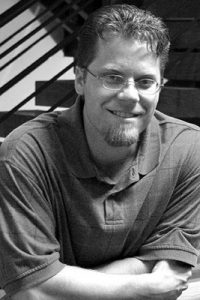
Chris Wynn, our chaplain, now gone to Colorado, fall 2004
“So when I was writing (to someone else) I was thinking I wanted to tell you. But since its you, I’ll say more: The people (caseworkers) that were with the children were all young (of course): Katy has been at it for three years & is very intense & real; Keisha started two months ago – shy, nice; Ashley came in late – she feels really solid. Sometimes I wonder, what did I do to deserve this – to be around people like this. Not to lay religious on you, but it can’t be anything but grace. And isn’t that a beautiful idea. End of email. The second day there were eight more children. This time Chris, a young man, intense, sweet-natured, solid. And Ashley again. High compliment to say, I’d take her on patrol. Reality is they’re taking me on patrol – lucky they’re short patrols. Students & I trying to get up to speed on exams, learning what we don’t want to learn; the students are doing a good job.”
Had lunch at Grace with students and Andy Macha. Was telling him about the situation with Jonathan’s Place – some of the emotion – and he gave me a teaching. From the perspective of his 16 years with Child Protective Services he talked with us about balance & perspective with the goal being to be better able to do a good job. 9/2003
Humbled – again: Last week was humbling. Actually, in this work, most weeks are humbling – if we pay attention to what is happening around us, with whom we are working, and what we are doing. First, there was a family from Chile. The wife was a university-educated midwife in Chile and is now working in a day care center. The husband was an executive financial analyst and is now driving a truck. Then there was a five-year-old boy without parents in the home. He is cared for by his 18 year-old brother who is not doing that bad a job. A woman brought in her feverish four-year-old daughter. Her husband, an engineer, has been out of work for a year and has come to Dallas to go back to school. Several people in the family have been ill, and they spent all their money on the first three people who were sick. We treated a 56-year-old dispossessed farmer from Zimbabwe. After losing his life’s work he is starting over in America. There was a two-year-old child with flaccidity, decreased intelligence and development, and the sweetest nature; and the most beautiful parents seeking, seeking that which cannot be found – hope for recovery. Ah, Valeria, beautiful one. And finally there was a 16 year old who brought her grandmother in. The grandmother is from rural Mexico and is unable to read or write. Her granddaughter works with us as a Saturday volunteer and is planning on going to Baylor or TWU to major in nursing. From generation to generation, country to country, hope to hope – how can we be so fortunate to do this work.
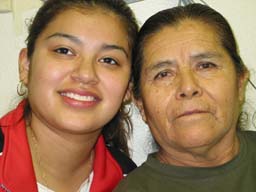
Consuelo and her grandmother
Eternal Things: Awhile ago a former student challenged me to focus more on the eternal. I was not sure how to do this, but my respect for her is such that I’ve kept it in mind, waiting, I suppose, for a sign. I know that we do the work of the Samaritan; and I know there is scriptural basis (in all religions) for such work, but it just seems like what we do. About a month ago we were asked to help care for Mr. S., a man with terminal illness. Mr. S. was a Parkland patient with no insurance or Medicare. The deal we worked out was that the Parkland nurse practitioner would see him several days a week and we would go on Tuesdays and Thursdays so the Parkland NP would have a break.
Mr. S. lived with his son and daughter-in-law, their three children, his wife, and toward the end, his two sisters – all in a two-bedroom apartment in South Dallas. The daughter-in-law did nearly all the care for Mr. S., and the sisters took care of the children, cooking, and so on. What a magnificent job the daughter-in-law did! What a wonderful family.
Last Thursday we were there, changing his dressings and getting him cleaned up. By this point he had gangrene in both feet and pneumonia; and the cardiac insufficiency that brought him to this point was worsening. Clearly he was close to death. As always, when we finished with the physical care, we had a prayer with Mr. S. and his family. Lupe (the Agape promotora) prayed with us and for us and as always, we were touched. Mr. S. died at home that night. I thought about the time we spent with Mr. S., and especially the last day and the last prayer. I think that was an eternal thing. 4/2002
Hands: I helped serve communion at Grace a few days ago. People came up to the front of the church and knelt and I served the wine while the pastor and a Cambodian girl served the bread. All kinds of hands – slender, soft, calloused, children, old – one man had a lot of prison tats and another (Asian) had a cross tattooed on the back of his hand. Later I realized that he was part of the Burmese (Karen tribe) family sponsored by Grace. I talked a little with him after church and learned that he worked with Dr. Cynthia Muang on the Thai-Burma border. Dr. Cynthia is a hero of mine. Small world. 11/2004
Thank you: My friend Chuck was playing poker last week and was dealt a straight flush! He showed up at Bible study with a check for la clinica. Here is my thank you letter to a good man.
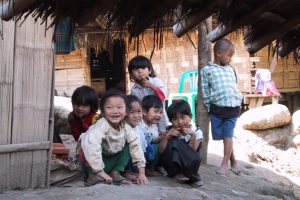
Refugee camp where Dr. Cynthia worked
“Thank you very much for your generous donation to the Agape Clinic. I think a lot about what we are trying to do at the clinic and why and whether we are wise in our work and our stewardship. The answers to the questions usually come from our patients. Here is what you are investing in …
Last week a woman came in with a complaint of several months of abdominal pain. She was seen by a nurse practitioner student with translation assistance from a 15 year-old neighborhood girl.
The NP student’s path is not all that different from mine – she is 50 years old and has worked in hospice for many years; and is in the NP program as a means of getting ready for the rest of her life. The neighborhood girl’s path – at least early on – is also not that different from mine. She is in trouble and working out court-ordered community service hours.
They were all in the exam room for a long time. Finally, the NP student came out and told me that the patient had been raped coming across the border some months ago, is having symptoms of pelvic inflammatory disease, and is depressed. She had never told anyone before now and was deeply distressed (meanwhile, the 15 year-old was sitting with the patient). We can treat PID presumptively, but this woman also needs HIV and other testing. So, we helped her get an appointment to a women’s clinic; set up for Lupe, our lay health promoter (salary paid in part by First Presbyterian), to go with her to the appointment; had a pretty intense prayer with her; started her on Paxil and pain medication; arranged for her to see a counselor; and moved on to the next patient.
The point (I think) is that all these strands (volunteers, students, troubled youth, donations, community, prayers, and more) come together in this safe place where mercy is practiced. Every one of the strands is critical. Thank you.” 7/2003
February 2004: It’s been an intense several weeks. It began with a child who had been raped and was dealing with it. Dealing with it! She had two very sad little sisters and was holding and comforting them. I don’t know what to think of that – there is more than one way. The whole thing just very sad.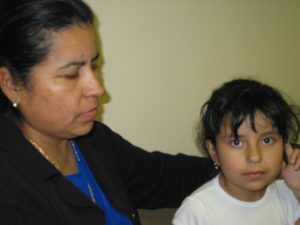
I went to a party where pretty much everyone from Common Grace Ministries was. I was a lot better off when I left than when I came. I’m really grateful to have been there. The thing about most of the people there was that they live lives seriously dedicated to Christ. Toward the end of the evening we sang songs like …
Let the poor man say I am rich in Him
Let the lost man say I am found in Him
And let the river flow
Let the blind man say I can see again
Let the dead man say I am born again
And let the river flow
Let the river flow
Last week the students on outreach saw a family with a history of several generations of violence and gang life. The focus of the visit was a child with uncontrolled asthma. Last year the mother’s boyfriend put a gun to the child’s head and pulled the trigger. The gun didn’t fire but lives already off-track swerved suddenly way out of control. The boyfriend is in jail, awaiting trial, but the child is having serious problems that are intensifying as the trial date nears. The dangers this family faces are short-term (this deal is not like litigation and some of the players are deadly) and long-term (how can this child stay out of gang life or a psychiatric hospital?). So here is what we did:
- Started the child on preventive asthma care and taught the Mom how to better care for the asthma and allergic rhinitis.
- Set the child up with same-day psychiatric care – the sort of care the Mother had sought unsuccessfully for months.
- Worked to ramp up support from other providers.
- Started the Mom on antidepressant/antianxiety medication and made psychiatric care available to her through our psychiatrist.
- Started the Grandmother on hypertension medicine.
Then we prayed together, “Father, Thank you for bringing our lives together in this moment …” We’ll follow-up next week.
Later in the day Esmeralda’s Mom came in. Esmeralda was killed in a fire Christmas 2002. I’ve known her Mom from around for 7 or 8 years. I had not seen her since the funeral.
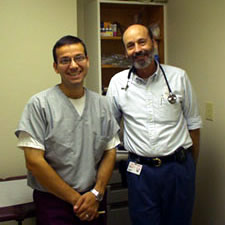
Estevan Garcia and me
A man came in seeking antibiotics, diabetes, and pain medicines. He had been discharged after 2+ weeks in Parkland with deep diabetic ulcers high up in one leg. He had been given a prescription for Levaquin (30 days worth – very expensive) and several other medicines and was unable to buy them. He had been off the Levaquin for several days – a dangerous thing to happen. We were able to (1) take care of the medicine and (2) accompany him on a six hour visit to East Dallas Health Center and help with registration and obtaining needed supplies and medications. This may save his leg. Leslie, our social worker took the lead on this and one can only stand back in awe at what she was able to do.
Last week we saw 102 sick patients; had 28 women receive mammograms (through UTSWMC); screened 40 people for HTN, DM, BMI, asthma, and so on; started treatment on several of them; held a class on women’s health for about 35 women; taught several classes of children; made 9 home visits; taught 8 nursing students, one seminary student, one FNP student, and one faculty member; participated in several miracles; and more. Thank God
Sadly Ridiculous: Rudy is eight years old. He was sent home from school on a Monday because he had tinea capitis (ringworm). His mother brought him to us Friday of that week because she was unable to register at the East Dallas Health Center (EDHC). That’s five days of school missed for ringworm! We treated him with medications supplied through a grant from the Open Ring Class and he is now fine and back in school. 2000
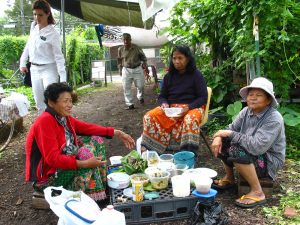
Community garden. Student on outreach
Frightening: Mrs. T. is 52 years old. She has diabetes, hypertension, and problems related to these, e.g., decreased kidney function, peripheral neuropathy, and other problems. Typically, she goes for days to weeks without medications, thus compounding her problems and hastening her first and inevitably early heart attack or stroke. We supplied her with some of her medications, spent a lot of time teaching her about the illness and self-care, and worked to get her registered at EDHC. She is now registered and receiving quality low-cost care. 1999
A Long Time: Mrs. C was a 58-year-old Cambodian woman who had undetected cervical cancer when we found her in door-to-door outreach. She lived in a one-bedroom apartment with her husband and three children: an eleven-year-old son with Down’s, thirteen-year-old daughter who provided most of Mrs. C’s care, and a fifteen-year-old son who was sent to prison midway through the course of care. Her husband was an alcoholic and not involved in her care. One of her neighbors, Pheng, took care of Mrs. C’s children much of the time. This was not a small thing, as Pheng lived in a two-bedroom apartment with her husband and five children.
Mrs C had a terribly difficult life. She grew up poor and in her middle years survived war, torture, forced labor, and became a refugee several times over. When I met her she was an alcoholic and abusive to her children. Mrs. C spent most of her days and nights lying on a small couch in the apartment living room.
Students and faculty were instrumental in the cancer being diagnosed, played a critical role in getting the patient through two courses of treatment (surgery and radiation), and took responsibility for her home care following crises related to very severe complications of disease, treatment, and her own well-hidden alcoholism (septicemia, stroke, seizures, bowel obstruction, malnutrition, and dehydration). For two years, Mrs. C received at least three home visits each week. She agreed to hospice care about two months before dying.
It was clear to all concerned that Mrs. P was spiritually bereft and without hope. Using both Buddhist and Christian translators, we tried counseling and to address hope and other spiritual issues in several different ways. Although she was nominally Buddhist, she refused offers of transportation to the temple. On several occasions she accepted gifts of objects sacred to Buddhists, but after a few days would put them away. Several Christian missionaries visited on a regular basis and although she did not resist these visits, neither did she respond to them. Everything we tried seemed to fail. She did, however, seem to appreciate our efforts to care for her and her family. The only thing that we saw that affected her was when one day a nursing student knelt unbidden beside Mrs. C’s couch and prayed. Although Mrs. C understood little of the prayer, tears began to run down her cheeks as the young woman prayed. Afterward, Mrs. C whispered, “Thank you.”
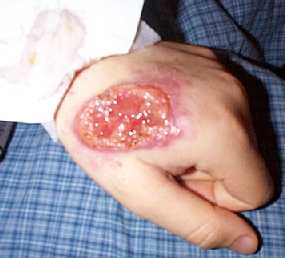
Schistosomiasis lesion
The week before she died I went out of town for a conference. I returned late Sunday. On Monday I left for work early so I could see Mrs. C first. I walked into her apartment and at that moment, she died. Two hours after she died, the only people left in the apartment were her daughter, one of Pheng’s daughters, and a gangster friend, Ranny. Ranny suggested that Mrs. C should have “something pretty” on. So we removed her clothes, bathed her poor wasted body, and dressed her in a pink T-shirt and her best sarong. Approximately 1996-98
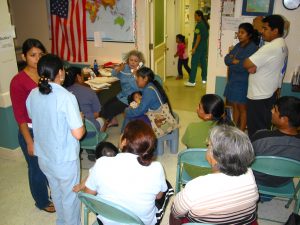
Waiting room. Leslie on phone
Strange People: In the course of outreach, one of the students made several visits to an apartment where a 60-something year old woman lived with a younger man and woman. The younger woman was very seclusive and every time we were there she had blood in her mouth (but no other evidence of trauma), and would not let us close enough to determine what the problem was. In conversations with the older woman we learned that the man (call him Jimmy) was “helping” a 10 year old girl who lived nearby. Over several weeks the story came out that the girl had a bad home life. Her mother lived with two men and was intimate with both. The girl was afraid of one of the men and so spent as much time as she could with Jimmy. She bathed at his apartment and at least once a week she spent the night with Jimmy, sleeping with him on a fold-out couch. According to the older woman, Jimmy and the girl liked to wrestle. Needless to say, when the story came out we took quick action. I remember the student on this case saying in a very serious way, “Mr. Kemp, I think there may be a problem here.” We talked with a detective of my acquaintance and he went after Jimmy and brought Child Protective Services in on the case. I do not know the final outcome, except that the girl was removed from her mother’s home and Jimmy disappeared. Good work, Dear student. 1995
Connections: Jessica came to the clinic with severe onychomycosis. We had enough itraconazole (a very expensive drug) to give her one pulse, which we did. We then contacted a dermatologist who gave us enough to finish the treatment. The last time we saw Jessica, her fingernails were growing out with no sign of infection. This was a good thing, but Jessica is not really the point of the story. Through the process of treatment, we noticed that Jessica’s mother, Maria, seemed distressed. We asked her what was going on and learned that she had no money, her children were going hungry at school, and her husband had been deported. Lupe, our lay health promoter helped get the children signed up for a lunch program and we were able to give the Mom some money. Here is the point of the story: Because someone noticed that something was wrong and Lupe was helpful, one of the neighbors called Lupe in the second week of December, to tell her that the Mom had been killed. The neighbor, Cecelia, took care of the children for eight days until enough money had been donated to send the Mom’s body back to Mexico.
The point for all of us is that we need to keep paying attention to what else is going on around us besides physical illness. Because someone noticed, we were able to participate in sending Maria home. 2000
A Hard Spring: In the spring of 2000 we (Baylor Community Care) lost significant medical services, had to move the clinic twice, were burgled, and an important working relationship came to an end. In our most difficult times in late spring and early summer, we were down to seeing 10-12 patients in one clinic session/week. Though it was a painful time, what stands out the most to me about this time is the people who stayed with the work: Estevan Garcia, Sharon Lehmann, Leslie Kemp, Alison White, Martin Hironaga, Debbie Schwartz, Lupe Springer, Martha Sanford, Marilyn Hightower, Kathryn Marshall, and Edwin Read. What a team! We are now part of the Agape Clinic, our situation is vastly improved, and the team remains largely intact.
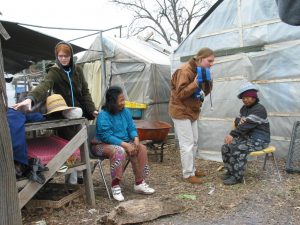
Outreach in the community garden
Pentecostal: I was in an exam room with a patient and a student. The patient was a Mexican woman who worked in a chicken processing plant. Her job was hard and entailed repetitive pulling and twisting (of what, I hate to think). As a result, she had a repetitive motion injury. She was treated with an NSAID and encouraged to talk with her supervisor about changing her task at work. The patient had some personal issues as well.
The student was a Pentecostal. I realized that while our medicine would be helpful to the patient, what would ultimately be most helpful would be the Spirit-filled presence and prayers of a person like the student. I feel something very real and fundamental about the Pentecostals who work with us – and there seems to be more of them as time passes. What a glorious time this is – when Presbyterians, Pentecostals, Catholics, Methodists, Baptists, and others can work together for the Glory of God – somewhere between heaven and earth.
Tattoo: During a clinic session at Midpark Place (an early clinic site in the Kurdish community), I fell into conversation with an elderly man who had brought a Russian Jew to the clinic to pick up medications. I noted the elderly man had a faded series of numbers tattooed on the inside of his arm, horrifying proof he had been in a nazi concentration camp. In that same room at that same time there were Baylor students (mostly Baptist), Catholic volunteers, Kurds (mostly Muslim), an Armenian family (history shows that Kurds participated in the attempts to exterminate the Christian Armenians 1894-1915), and a Buddhist caseworker. Moments like this help me remember the beauty and power of this work. 1997
Reach Clinic: Awhile back a woman brought a 22 month-old girl in to our clinic. The child had two problems: (1) a “rash” that turned out to be genital warts and (2) a prescription for a medication for the warts. The medication cost $140+ and the woman could not afford it. She had been given the Rx at a clinic (the Reach Clinic) that treats children and infants who have been sexually abused. Dr. Garcia called the clinic and was told that the prescription can be filled there and an appointment was made for the woman to bring the child in next week. We followed-up and discovered that the woman did not keep the appointment. After several more contacts back and forth, the child got back to the Reach Clinic and received her medication. Not everything is at it seems initially and sometimes people need a lot of encouragement. 2000
Home Visit (from a student’s clinical log): Thursday, my partner, April and I went to visit a patient with diabetes, lupus, and hypertension. She was noncompliant with her medications she was supposed to be taking; and was taking at least one medica
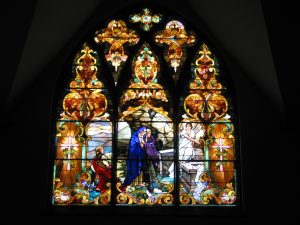
Window at Grace Church where clinic was
tion (hydrocodone) that was intended for someone else. She said she had been taking the hydrocodone along with her medications when she remembered and she never looked at the name on the bottle to see if it was hers. There were 12 out 24 pills left in the bottle. She said after she took the medication she felt very tired. She told me about something that happened last week that I found very interesting. An Angel appeared to her when she was sick and said, “Come on. It is time for you to go you are very sick”, and Ramona (the sick lady) said, “No I am not ready to go.” Still in Ramona’s dreams she can see the Angel’s beautiful eyes and she feels that she is having an out of the body experience and the Angel is carrying her. I asked Ramona if she had ever asked Jesus Christ to be her personal Savior and to forgive her of her sins. She started crying and said, “Yes I have.” I then asked her if she and her friend would like to pray. They both said yes and we all joined hands and I prayed for them. I referred Ramona’s friend to Parkland, for pain and discharge from her left breast. She called while I was there and made an appointment for that day. 1999?
Split Shift: I was seeing a ~50 year old woman with diabetes and an inf
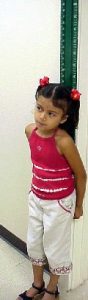
“Not too tall”
ected toe (Those go together – horribly in some cases.). Somewhere during the exam I realized she worked at a major hospital. I was irritated. We are a small overloaded mission clinic serving people who have nowhere else to turn; and of course this woman had insurance. I told her we would take care of her infected toe and tide her over with oral hypoglycemics. But she should use her insurance and see a private doctor or go to the hospital clinic. While I was getting her medications, she told Lupe (our promotora) that she worked for a temp service and did not have insurance. Lupe told me when I came back into the exam room. I felt small – so much for my cheap irritation. I asked the woman to come back in the following week first thing in the morning, fasting, so we could get a better picture of her blood glucose. She then told us she worked a split shift – 6-10a and 4-8p. Have you ever worked a split shift? It is really hard – you’re never really off. So this is the life our patients lead – very, very hard; out of meds half the time; putting up with irritated clinic people. When she returned three weeks later (no diabetes meds for the last two weeks) she told Lupe she actually did have insurance, but did not know how to use it. This also is the life many lead – paying (top dollar, I might add) for something they cannot use. She is scheduled to return next week for a blood glucose check and help from our social worker to be able to use her insurance. 2001
On Columbia … There are women walking children to school
You are the salt of the earth … you are the light of the world … Matthew 5