Pure Autonomic Failure/PAF 4: Notes on the Lived Experience

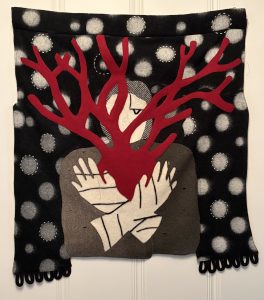
Holding My Heart. Jean Cacicedo. Wool, dyed, stitched. 2026, 34”x38″

“It’s hard. The main thing,” Jean says, “is unpredictability.”

“The main thing is unpredictability — if and when you’re going to feel bad. Obviously after every meal, but there are other times as well. The lethargy. The physicality of it — kind of numb throughout the body. Exhausted. Balance issues when walking — I feel like I’m walking drunk, that’s why I have to sit a lot. I feel like I’m on display. Disconnected. Don’t feel right. Don’t feel sick. Not getting blood to your body — it feels like the walls closing in. It happens a lot. Feels like you’re going to faint even after getting ready for bed — but not every night.”

That description — precise, physical, disorienting — is what PAF actually feels like from the inside. No test captures it. No chart note records it.

The complexities of daily management (medications, fluid, sodium, activity, etc.) coupled with whatever other health problems one has can be overwhelming. For example, the effects of PAF on blood pressure and heart rate have, I believe, led to persistent atrial fibrillation (AF) and congestive heart failure (CHF).

Technical medical discussion paragraph: AF and CHF coupled with the exercise intolerance inherent in PAF create challenges in daily life and the work to improve physical conditioning. When CHF is paired with PAF there is a therapeutic conflict between the high sodium demands of PAF and the low sodium demands of CHF. There is also therapeutic conflict between the high fluid volumes needed in PAF and the lower fluid volumes needed in CHF. If this seems technical and complex, it is. The neurologist and cardiologist seem to find it so as well. In our “siloed” health care system the neurologist wants the cardiologist to deal with heart issues and the cardiologist wants the neurologist to deal with autonomic issues. However, these are inextricably bound together in the understanding pathophysiology of PAF. Teaching is minimal. The bottom line: I figure it all out.

The heat intolerance of PAF means that one literally cannot function in a hot climate or on a hot day in a cool climate.

Severe dry eyes require constant management.

The chronic constipation of PAF is complicated by occasional episodes of sudden, severe diarrhea.

When flying with PAF, respiratory distress may be experienced while the plane is ascending and descending. Thus flying is a fearful event. I just purchased an oxygen concentrator to use while flying and have exercises that may help. We will see.

As with other chronic illnesses, PAF affects the entire family; it is truly a family illness.

Invisible and unexplained

PAF is classified by the NIH as a rare or orphan disease. That rarity has consequences that go beyond statistics. Most physicians have little familiarity with it — and some seem to reason that if they haven’t heard of it, it probably isn’t serious. Emergency personnel are largely unaware. Some know something about the more common dysautonomia POTS (postural orthostatic tachycardia syndrome), but PAF is less common and less recognized. Friends and family don’t understand what’s wrong, and explaining it soon runs into blank looks.

The institutional consequences can be surreal. My HMO refuses to include PAF in my chart’s problem list, on the grounds that PAF does not appear in the ICD-10, the World Health Organization’s International Classification of Diseases. No code, no diagnosis. Never mind that the condition exists and requires active management. The problem list is precisely what emergency personnel read first when a patient comes in unable to speak for themselves.

I live with moral injury related to the injustice of medical dependence on a system and individual doctors that will not give me the diagnosis that I live with and the collaborative health care I need.

The work of it

Managing a complex, dynamic chronic illness is genuinely demanding. Symptoms shift hour to hour, day to day, week to week. Staying ahead of them requires attention, discipline, and knowledge that most patients have to acquire largely on their own.

I’ve been fortunate to see an out-of-network autonomic specialist once a year. The Facebook PAF group provides information and community, and coordinates a biweekly Zoom support meeting — often with a prominent autonomic specialist in attendance. These are the resources that actually help. My HMO provides neither education nor support for this condition.

The social calculus

PAF quietly reshapes ordinary life. The postprandial BP drop means that walking to the car after lunch out is an effort requiring calculation. Sitting around the table after dinner becomes difficult. A museum is best taken in small increments, with a rollator — a wheeled walker — as an essential tool. Socializing requires planning that healthy people never think about.

And then there is the gap between appearance and reality. People assume that if you look fine, you are fine. You may look great. You may not feel great. That gap — between the face you present and the body you’re managing — is one of the quiet costs of living with PAF.

Finally

Having PAF is hard, stressful. I’ve experienced almost everything we’ve written about in this guide, except for phenoconversion and some of the testing. I am grateful to my autonomic specialist consultant, to friends and family who have stayed with me, to doctors who have tried to understand and help, and to the PAF Facebook group.

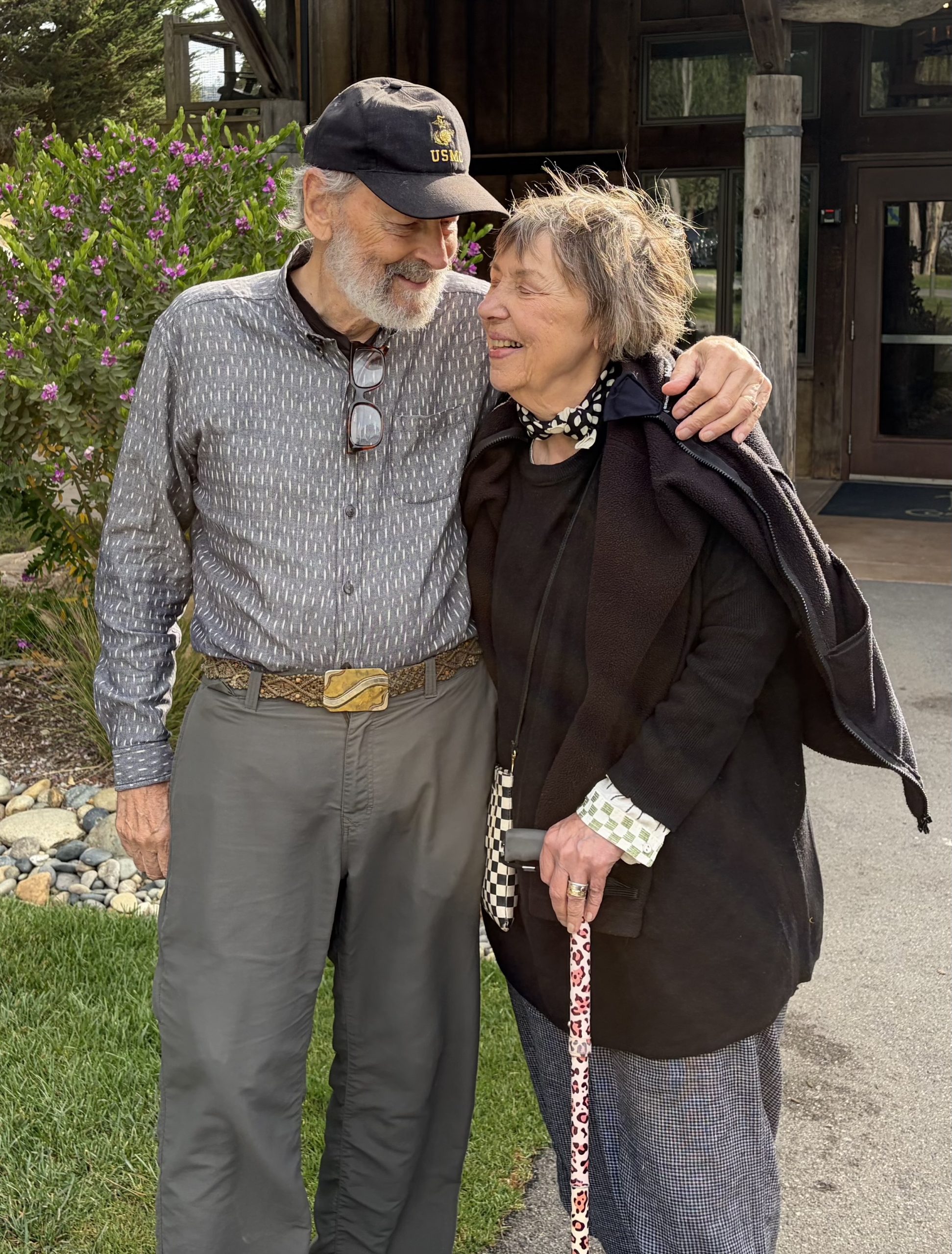
We, Charles and Jean, are grateful for one another.

This guide is for general educational purposes only and is not a substitute for professional medical advice. Always consult your physician regarding your specific condition, medications, or treatment. Medical information changes frequently; verify drug names, dosages, and current guidance independently. The authors disclaim liability for any injury or damage arising from use of this information.

“Walking downhill in Paradise”

Avenue of Trees on the way into cabin near Mendocino

Parked on Cedar Street, walked past one beautiful garden after another (it’s mostly gardens here, not lawns), walked past the original Peet’s on Vine at Walnut and down to the Cheese Board Collective on Shattuck. Standing in line at the Cheese Board today, surrounded by people more or less like me. What a great thing to be able to do this quintessential Berkeley thing, walking through a beautiful community and standing in line for a great bakery. People and dogs walking by, people sitting and standing at the sidewalk tables, babies and old pe

Red Sea Orange Feather

ople and everyone in-between. Inside, past all the great cheeses and on to the bread counter. Got sourdough batard, spelt loaf, cheese roll, double chocolate cookies. I do this once a week, along with trips to a truly great produce market and to the big and unique Berkeley Bowl.

In the past two months we had lovely three-day visits from David and Charles and from Jean’s niece Anne and her great niece Beatrice. They were the first overnight visitors we’ve had since the downstairs bathroom was redone and everything worked well.

Red Sea Orange Feather

Drove to Carmel for a show at the Carl Cherry Art Center featuring Jean’s and Janet Lipkin’s work. It was the first time I’ve seen Jean’s work on a person and finally I really get it that these coats she’s made are sculptures. https://carlcherrycenter.org

Peter Goodman wrote a book about his family bakery on Telegraph Avenue in the 1950s and 60s. The Berkeley Historical Society sponsored an event around the book and about a hundred people showed up. Lotta white hair and canes in that crowd!

The mighty Pacific from van

Drove to Mendocino. Stayed in a nice cabin across from the small town of Mendocino on the other side of a fjord-like inlet along the Pacific coast. From Mendocino you can barely see the cabin on the headland among the trees. Spent a beautiful day at the Mendocino Coast Botanical Gardens. The dahlias are in full and breathtaking bloom. https://www.gardenbythesea.org

The journey with getting the VA to recognize my service-related challenges is over with my goals achieved.

Watching the sun go down behind Mount Tam with the mighty Pacific stretching endlessly beyond into the great beyond. And in the morning in the hot tub looking out over the SF Bay with fragrant Philadelphius flowers hanging down above us.

Morning from deck

I’ve been writing my obituary and planning my funeral. One of the “tasks” at the end of life (or, preferably before the end of life) is a “life review.” Involvement in hospice and related work has led to an understanding of the importance of reviewing and an obituary is really a summary statement of review (and thus is worth doing).

Happy Birthday in Mendocino Coastal Gardens

I flew to Dallas for an appointment. The flight was scheduled for 6pm, delayed until after 8pm, and after an hour and a half, turned around and went back to Oakland. There were emergency vehicles lined up where we landed, but nothing happened. The passengers all disembarked, walked to another gate, and got on another plane. I got home at 5:37am, took a quick nap and showed up at 8am appointment, then went elsewhere to transact business (feeling impaired after 24+ hours awake).

Going to friend’s homes for dinner or having people over. Meeting friends for lunch. This week we celebrated my birthday with Jean at Dalida in the Presidio. Nancy and Peter had us over for another birthday dinner and we had Andy and Simone over for dinner the next evening. Happy birthday, CK!

Morning – in hot tub looking up

Peter N-R and I were walking home from lunch at the Kensington Inn. It’s an uphill walk – uphill is getting harder and harder – to get there and a downhill walk going home. Peter said, “We’re walking downhill in paradise.” That’s right.

A dream about grassroots grant-writing (of all things)

I’m grateful for this dream. Jean and I are in the habit of lying in bed in the mornings, having coffee, talking, watching our “today show” (the sky, birds, the SF Bay, the Marin hills, and whatever else we can see from bed), and having a short meditation on what we’re grateful for.

One thing about this dream is that the two themes were so vivid and intertwined – one theme being our surroundings as we walked along and the other theme being what I was saying and thinking. My recall of the details of the dream is far greater than most dreams I can remember.

_____________

The dream: Jean and I were walking in a warehouse district on the edge of downtown Dallas. I was telling her about the grants research and writing process I used beginning in the early 1980s. We were holding hands and walking through vacant lots and deserted buildings and…

I was telling her about the foundation directories I found at the Dallas Public Library, going through these big books page by page writing down information on foundations whose areas of interest matched my own (especially healthcare, refugee, and justice issues). I also kept information on foundations with board members I had some connection with, no matter how small. I was thinking in detail about the area of the library where the foundation books were kept.

We were walking on paths winding through dry, sun-blasted vacant lots and sometimes on concrete floors with broken glass in big empty buildings like old steel mills. There were a few people around – they seemed like about who you’d expect in that sort of environment, many broken, some might be dangerous, and I was greeting people the usual way: “Hey now” and I was talking about …

the proposal-writing area in my office – a ~3×8 plastic table divided up into labeled squares for the documents that had to accompany proposals, like 501 (c)(3) docs, annotated board member lists, budget documents, etc., etc. and telling Jean about sending proposals every few weeks, each one rewritten and better than the previous one. At the same time I was teaching and volunteering and delivering services – building a reputation and I had a reputation.

The environment we were walking in was deteriorating, becoming a little more ominous, a real desolation row. I was glad I’ve been in these sorts of places before. A mentally ill kid, a teenager walked alongside of us for awhile. We walked past a woman with eight Doberman pinschers. I was relieved to see some condos ahead, but when we got to them we realized they were public housing projects and run-down like everything else. A young woman met us as we were walking up to the buildings. She was a little weather-beaten, tanned. She was wearing a green skirt with a fringe on it; she was looking something like some of the people at the Rainbow Gathering, pretty run-down herself. She offered to take us in to one of the apartments to “see Don” – I said “No, but thank you” and she was like a classic case of a shrug and whatever.

I was telling Jean about writing proposals for Vietnam veterans services, refugee health, and drug treatment and prevention. I knew I wouldn’t get funding from my first proposals, but I didn’t care; I was learning how to do it. I started with the most obscure and least likely foundations and worked my way up the ladder to bigger and better-endowed ones.

Everything was pretty desolate and we couldn’t see downtown anymore. I jumped across a ditch and Jean took three steps to her left and got across on a level place. We were both getting tired (but there was no place to stop). I asked Jean if she needed to pee and she said no and then I awoke and got up to pee. That was the end of the dream. I wrote all this down at 0530.

___________________

In most years when I was writing I averaged bringing in around $100,000. I also initiated other means of development as it’s essential for nonprofits to have multiple streams of income. I never saw any of the money personally, but I accomplished most of what I set out to do: a lot of people got help – from broke-down veterans to “jaded, faded junkies” to children impacted by drugs to refugees and immigrants from across the world to children who were abused to people at the end of life. I had a dream of the world as a better place, less suffering, more justice, all that.

Money for changing the world https://ckjournal.com/money-for-changing-the-world

Afternoon magic, The Dreamer, gratitude for her presence, love on the way to the toilet, what matters now, epic journeys, John Chase, years of living dangerously

David, Jean, The Dreamer in David’s office

In the afternoon, taking a short nap, then lying spooning, tangled up together for I don’t know how long – 20-30 minutes, warm, so comfortable, comfortable physically, emotionally, puppies, lovers, friends, the afternoon sun starting to come in the doors, crystals sparkling, alive, rainbows on the walls and our bodies, knowing that literally this is as good as it gets, grateful. Remembering and writing this is as close as I can come to preserving the magic.

The Dreamer photo was taken in David’s office at UC Berkeley. Jean gave him The Dreamer. When we put it up, she explained some of how and why she made it. It’s felted wool. All of the lines on the body and face were sewn in and everything was shrunk.

Another day, kind of cold, taking a nap. Under the covers I encircled your warm, soft right thigh with both hands and we fell asleep like that… and awoke 20 minutes later – like that. This too, is as good as it gets.

The Chancellor’s Garden – in the Berkeley Hills

—————

Going through flyers and things related to events I’ve attended (mostly psychedelic forest gatherings) I ran across this from an Each Moment Matters event:

Remember not that she died; but that she lived.

Of course it’s not one or the other; it’s both, in varying degrees. But there is movement toward more good days than bad. And now, five years later, the days are all good. I think of Leslie a number of times every day. Her presence is like an overlay to my life and I think of her more in brief moments than in endless sad ruminations; more in gratitude for her presence in the world and in David’s and my life. More in being inspired by her. Just the love. Not the awful pain.

—————

I told my doctor that when I was getting up four times a night to pee, it was okay, because I’m happy, including when walking in the hall (“with hangings rich of many strange design”) on the way to the bathroom. But five times is too much.
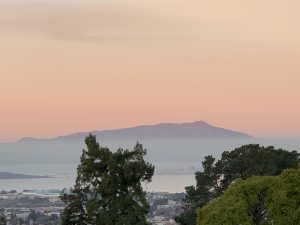
Morning has broken, like the first morning…

—————-

We were talkingabout being with a friend with ALS – a friend who is moving inexorably toward the end of life, who is unable to speak; but who can use her eyes with a computer to spell out messages. What do you say when there is nothing left to say? This specific question emerged:

What matters to you now?

Burning Man art – at Oakland Museum (Kristina!)

And it’s a question for us all, all the time. What matters now? Jean asked her friend this question. Love was right there at the top.

We see that personal growth can be part of the process of dying; that values clarification has value until the end; that the human spirit turns toward the light – toward love.

—————

Jean’s sister, Ginny and brother-in-law, Jim were here for a couple of days. They had flown from Tucson to Chicago, then caught the California Zephyr (Amtrak) to Denver, through the Rockies, across Utah, through the Sierras (all of this in deep winter), and on into Oakland. From Oakland (Emeryville) they’ll take the Coast Starlight to Los Angeles and from there, the Sunset Limited to Tucson. Pretty cool!

Back gate I made for Dallas house

Years ago, Jim’s doctor in New Jersey told him he had to quit smoking or die. So he flew to the west coast and rode his bicycle back to the east coast and by the time he got to the Atlantic Ocean, he had truly quit tobacco. Epic.

I was looking at Ginny and Jim’s New Zealand cycling blog: 59 days, north to south, 30 nights in a tent, seashores, up hill and down dale. More epicness. This man understands epic journeys.

So I was thinking about epic journeys in life. It’s worth thinking about. Some of my epic journeys are 13 months of combat, the hippie years, taking care of Leslie at the end of her life, a 10 day solo trek into the Wind Rivers wilderness, and other journeys across geography and mind/heart.

—————

From the deck

In 1988, when I was operating community health programs out of the East Dallas Police Storefront, a police officer was murdered in downtown Dallas. John Chase was shot three times by a homeless man who had grabbed John’s pistol. John pled for his life while a crowd was urging the man to shoot: “Kill him!” they were shouting. “Kill that white mother-fucker.” I had only met John once, but the killing hit me hard because he was a nice guy and because nobody tried to stop the killer. Afterward I made a clear commitment that I would never let something like that happen in my presence, regardless of the risks. I’m older now, and not much of a badass, but here it is again: the same commitment to the memory of John Chase.

As with all other murders, John was autopsied. His partner, Gilbert was there for the entire procedure. Gilbert is a true warrior.

—————

Can you see how this blog functions as a kind of memoryizer (new word meaning promotes remembering)? I guess it’s a way of keeping my shit together, as we used to say.

—————

Sunset from the deck. NOT Photoshopped

My high school class (1962) has a Facebook page. 20-25% of the class is on that page. It’s nice. Everyone on the page is about 75 years old. There are all kinds of realities associated with that age. In a recent discussion three people noted that they are homebound. Death is near for most of us and not far for the rest. I recently posted on that FB page:

These are truly the years of living dangerously. A classmate’s recent listing of classmates who have passed (about 20% of us) was such a powerful document. And here we are, still living after all these years! We’re all kind of like people living with cancer (and some actually are) – each day, each moment, each touch, each kind or loving word… Treasures. Here’s to each one of us, here and not here.