Planning hospice – spirit

I found the first explication of what I was trying to trying to do for most of my life. It is in a memorandum written in 1978 to Elsie Griffith, the executive director of the Dallas Visiting Nurse Association. At the time, I was working on planning and implementing the VNA Terminal Care Program, which was foundational for the first hospice in Texas. In hospice we focused intensively on managing physical symptoms at the end-of-life, such as pain, nausea, shortness of breath, etc.; and on supporting families. The subject here is the spiritual and ethical structuring of this work. It’s hard to believe I sent this and that Elsie accepted it and believed in the vision. Here it is, exactly as I sent it:

——————

June 9, 1978

To: Elsie Griffith

From: Charles Kemp

I feel a strong need to express something that is difficult to express— namely, the spirit which I think should be part of our terminal care program.

I hope we all recognize that the way we die in America is generally poor. To illustrate this let me tell you about a situation I am presently experiencing: Several weeks ago someone called me to say that a friend of theirs was dying of cancer of the breast metastatic to brain, ribs, spine, abdomen, etc. and would I see what I could do to help. The person in question is a 41-year-old woman (Jan) whose 2 teenage daughters live with her husband in another residence. Jan’s mother has been taking care of her for about 7 months and is physically and emotionally exhausted. If relief is not forth coming, Jan will have to go to a nursing home. We have been helping with home health aides and nursing but it’s not enough.

I went to see Jan on a Friday night before I left for a week in California. I found her to be in excruciating pain and to have paraplegia. There were only a few hours left before I had to leave town and although I tried, I could not find any relief. When I returned from California I called and discovered that Jan was on the way to a nursing home.

After visiting her once and seeing what the situation was I committed myself to stay with her 2 nights a week. I can’t say exactly why — I’ve never done this before — sometimes something happens when people meet or when situations present — maybe I ‘m seeing me or my wife — or maybe I have the need to stay grounded (as much as is possible) in the reality of dying as I plan for helping people die as humans.

Staying in a nursing home at night is a strange, sad, and sometimes bizarre experience:

Me: “She needs something for pain”
Nurse: “I don’t work that hall.”
Me: “Where is the other nurse?”
Nurse: “He’s gone.”
Me: “When will he be back?”
Nurse: “15 minutes.”
Me: “She’s really in a lot of pain.”
Nurse: “I don’t work that hall.”
Me: “Are you saying you won’t do anything?”
Nurse: “I don’t work that hall.”

At midnight an aide walks in, turns the light on and off and starts to walk out. I ask her what she’s doing. “Checking the light.” — and out she goes.

Ice pitchers are filled at 5:30 A.M.

And much more. It’s a kind of dumb, passive brutality.

I know you’ve heard and seen a thousand variations on thig sorry tale. You know about the terrible loneliness and dehumanization of dying. You have in your possession some scientifically-oriented things I’ve written about this. So probably I’m trying to touch you with something that is touching me very deeply: The spirit of the terminal care program:

To be touched and to be able to touch people who are lonely and afraid. To be not afraid to feel. To work from the mind and the heart. To experience the personal loneliness and fear that lies within (us all). To care enough not to need to be the hero. To work through the family. This is difficult for me to express. I’ m not looking just for increased services; I’m looking for something that will touch people at every level.

When these things are happening, the people (nurses, aides, social workers, doctors, volunteers, etc.) who are experiencing them need to have to have an incredibly strong support system.

I tell you, I am committed to planning and operationalizing a program which will give what is needed. And I’m firm in my knowledge and belief that this spirit I have so inadequately expressed above is vital to meeting the needs of people who are dying.

Thank you,

—————–

Jan went home a few days later and she died peacefully at home a few months later. She was a brave woman.

The night in the “dumb, passive brutality” of that nursing home was inspirational to me. I’m not saying that over time my colleagues and I ended the ugliness, but at least for people with end-stage cancer, ALS, and other afflictions there are now much kinder, more supportive, and more clinically effective options all across America – and that’s exactly what we were aiming for.

10 years ago, a few days in Vietnam

2013 was a great year, 2014 was a hard year, 2015 was impossible

Two friends were here for dinner yesterday evening. At some point we began talking about what we were doing 10 years ago. Not surprisingly, there had been changes and losses for all of us. Here is a partial account of what I didn’t say.

There was music at the party

10 years ago on New Years Eve of 2014 I was at a gathering with other members of the Atrium Obscurum crew, the people I worked with to put on forest psytrance events. It was an all-night psychedelic party, with most people tripping and others rolling. At some point we gathered around a firepit behind the house and had one of those ceremonies where everyone writes on a piece of paper something they want to let go of from the past year and then one by one, say a few words, and toss that burden into the fire. When it was my turn I said that 2013 was one of the best years of my life and I had nothing to unburden myself of. I said I hoped 2014 would be as good.

A few months into 2014 Leslie began to decline and 2014 got harder and harder and harder until in March of 2015 she passed away. Then the grief. Late 2014 and into 2015 was one of the two hardest times of my life, the other being my 13 months in Vietnam. Below is brief description of a couple of days in Vietnam.

2024 is unfolding as a good year.

———————

At the “The Hill Fights: The First Battle of Khe Sanh”

I came in with another man on a helicopter to link up with B/1/9 (B Company, 1st Battalion, 9th Marine Regiment) on an operation at the DMZ. When the helicopter came in to where B Co was in those dry hills, the LZ was getting hit with mortars. I didn’t know what was happening and it was a complete surprise when the chopper was about 10 feet off the ground and the crew chief put his boot in my back and pushed me out, followed by a rain of ammo, C-rations, etc. they were tossing off the chopper. There were a lot of mortars coming in, too and I made it to a little hole full of Marines. When I dove in on top of them some lieutenant was telling me to get the hell out and I was just burrowing into the pile, not going anywhere.

The next thing I remember was described in the book, “The Hill Fights” by Edward Murphy. Murphy is writing about someone named Montgomery:

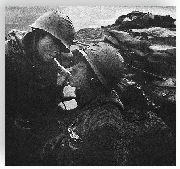
I took this somewhere at the DMZ. They’re loading weapons left from KIAs and WIAs. Two men in foreground are WIA.

“Corporal Montgomery struggled with the heavy load his team carried as they sought cover. They had almost made it when a brace of mortar shells crashed behind them. The twin blasts threw Montgomery into the brush. When he came to a few minutes later, blood flowed from shrapnel wounds in his right thigh, right hand, left arm, left buttocks, and the right side of his neck.

He says, ‘I looked around. No one else was there.’ Mortar shells were still exploding along the ridgeline… I was afraid I’d been out for a while and had been overlooked in a withdrawal, so I crawled on all fours to a nearby bomb crater. I hurt too bad to go any further, so I started calling for help.’

Two marines hiding in another crater answered. As soon as I told them that I was wounded they crawled over and patched me up. ‘Where is everybody?’ Montgomery asked. ‘Where did they go? Are they all right?’ The two marines told him what they knew which was not much, then Montgomery asked them for a favor. Montgomery pulled a camera from his pack and handed it to one of the men, and with mortar shells crashing behind them the man took Montgomery’s picture. ‘What a souvenir that’ll make,’ he thought. As soon as the mortars stopped Montgomery’s two new friends helped him back to the main body.

(I was the man who took Montgomery’s photo. He was sitting in the dirt in the crater, very bloody, smiling, shooting me the finger.)

Minutes later without a word everyone began to move out. The few remaining able-bodied Marines grabbed the wounded and dead and started humping. The men moved with a single-minded goal: get out of the killing zone. The NVA was not going to let that happen.

About ten men made it safely over the ridgeline before the mortars came again. In rapid succession more than a dozen high explosive shells wracked the column. Marines dove left and right seeking cover on the barren hillside. Still, chunks of hot metal found flesh. Up and down the column men were crying out in pain. Some were wounded for the second time that day. More than half a dozen were also freshly wounded and desperate cries of, ‘Corpsman!’ ‘Corpsman up!’ echoed across the hillside. This attack pushed B/1/9 to its limit. They were burdened with more casualties than they could carry, without food for two days, with little water, low on ammo, and without any prospect of evading the enemy. Some in the unit saw no sense in continuing this way. The ambulatory and uninjured might make it to Khe Sanh if the dead and the badly wounded were left behind. Captain Sayers never considered this. Bravo company would succeed or fail as a unit. That was the way it was. There were no other options. The survivors would sell their lives for a high price, taking as many enemy with them as they could.” END QUOTE

Somewhere on the barren hillside, not far up the trail, we got the wounded man to safety. There was a depression in the trail and there were people tending to a another wounded Marine there. He was dying and they were trying to save him, but when they turned him over some of his insides fell out of his back and he died.

In thinking about this I’ve never been able to remember where the trail finally went. Now I know. Farther up the trail a few helicopters came to take out the last casualties and by the time they got to the dead men, there was extra room on the last chopper. So I got out safely and B/1/9 was linked with K/3/9 (K Co., 3rd Bn, 9th Marine Regiment).  

In November 2009 I wrote about what happened with me next:

After it was over, 1/9 Marines carrying the dead

(11/2009) I was flying out of an operation, in a chopper with a lot of weapons and several bodies. We were flying low, coming up on any enemy too fast for them to hit us except they did, bullets banging into the chopper and it started spinning except the pilot flared it some and though we slammed hard into the ground. It wasn’t a disaster – except for the fact that we had just been shot down by people with bad intent who were undoubtedly headed our way from not very far away. We set up some guns and in just a few minutes we began to take a little fire and then another chopper got there and we dragged the bodies to the other chopper and got out of there (calling in artillery fire on the downed chopper).

——————-

Writing this has been a comfort to me. It doesn’t really bother me much anymore. It’s crazy to think that these things and more happened. The comfort I take is related to the war in Ukraine. I’ve been worrying about the Ukrainian soldiers who are going through heavier combat than I ever did. How can they process it later in life? As I reread the above, I think that if I’m OK, maybe some of them can be, too.

——————-

I read all this to Jean. I am thankful to her for hearing it.

Eat your fruit cocktail first

It was a misty, drizzly day, a little cool for the tropics, for once. There were about 10 of us on patrol near some deserted villages. We came upon a small, ruined temple with some walls still standing and a little bit of roof. We stopped there, put a few men on watch, and 6 or 7 of us leaned back against those walls “inside,” smoking cigarettes, talking, dozing, being dry. It was one of the best places I’ve ever been in.

This getting old is getting old. It really feels sometimes almost like combat – it’s dangerous and the casualty rate is certainly high. In combat and in aging, tired much of the time, sleep difficult, too much discomfort. Many of us are taking some strong drugs, too: blood thinners, heart rate regulators, and so on. And the ever-present land mines of falling and accidents. Sooner or later we’re all going to get it. But at least we aren’t all sweaty and smelly now. We don’t have to sleep on the ground, we aren’t eating C-rations, we don’t have to walk around in the rain, our clothes aren’t filthy, nobody is actually trying to kill us, we’re not carrying 40 pounds of guns and ammo along with other gear, the list goes on and on.

Grateful to be.

With all that in mind, here are the rules of the road:

Keep your weapon ready.
Keep your cigarettes dry.
Eat your fruit cocktail first.

Which is to say, keep your shit together (take your medicine, watch your step, drive carefully) and enjoy that fruit cocktail (the best thing in C-rations), because it may be your last.

She called just to say goodbye

I used this in hospice training in the late 1970s. It is the profound universal message of our common human need for witness to our lives and to our deaths. It is the same message that Jesus gave when shortly before he was tortured to death, he said, “My soul is very sorrowful, even unto death; remain here, and watch with me.”

SHE CALLED JUST TO SAY GOODBYE

By Lynna Williams

Star-Telegram Writer

In a long and good life, she married the man she loved and together they loved two sons. Now she is dying and who will hear her goodbyes?

Not her husband or her sons. The oldest son died in the France of World War Il two days after his last letter arrived safely home. The youngest was buried next to his father in a Fort Worth cemetery.

Not other family. She came to her marriage from life as the adored only child in a West Texas home. Mama and Daddy died within a year of each other 48 years ago.

Not friends. Those who meant something to her are dead, their obituaries neatly clipped and filed in a front room desk.

But, although she is alone, she wanted to say goodbye. She wanted even more for someone to hear. The voice that called the Star-Telegram newsroom Tuesday was somewhat hesitant but firm about the purpose for the call: She had something to say. Could someone listen?

Assured that someone could, she began to talk. Her name wasn’t important, she said. Her need for a witness to her life — even a stranger — was.

She was born in Abilene 81 years ago. Nothing has ever come between her and memories of the house where she grew up, not distance and certainly not time. She can remember it now as clearly as if she stood on the freshly painted porch. She can see the oak tree where she played and where folks gathered on Sundays for prayer meeting.

Her husband-to-be was a boy of 16 when they met at a girlfriend’s house. She remembers betting with the friend — a daring act for a gently brought up girl — that he would marry her.

He was over 6 feet tall and when she looked at him, something caught in her heart. She remembers that feeling, too, so clearly that retelling it makes her sound, for a moment, almost young again.

They married and moved to Fort Worth. She hated the town on sight — her husband laughed at her for missing the West Texas “scenery” of Abilene — but she wrote her parents every day and she survived.

Two years after she became a wife, she became a mother. First, Bill, who “never met a stranger.” Then, Hal, a boy who became his beloved older brother’s shadow.

The voice on the phone stops. Is the taking up too much time? She almost laughs at that and makes a joke about being short of time. The voice is stronger, as if memories give her strength.

They were a family. Her boys had their own front porch to grow on. There were picnics and conferences at school with their teachers. Bill was the class cut-up. Hal was too shy but was the best of boys.

Hard times came. Her husband’s first small business failed. But the family was together and they survived. Where did the time go? She wonders that now, but cannot remember if she noticed the days slipping away then.

Bill was dead. Thirty years have passed but she remembers that day as if it were filed with the other obituaries in the front room. She cried. Her husband cried. Hal shut himself in the boys’ bedroom. When he came out, he was changed in a way that made her heart ache. He never spoke of his brother again.

She got through the days when Hal was overseas by praying he would come home again.

When he did, their life went on. He stayed at home after his return and helped his father with the family business.

Hal was at his father’s side when he died in 1967. She had left the hospital room for a minute and the way she felt seeing her only child bent over her husband is a memory, too.

Her son died four years ago. He was never anything but her best boy. When she thinks of her husband, she sees his face. With Hal, it is his smile. Bill has become the picture on the mantle, the eyes under the Army visor.

She has lived her life since then alone in the house with the front porch where no one plays now.

She became more and more alone as the years went by. Fewer faces at church were familiar. She was an old woman and who would take the time to get to know her?

Her heath, always good, began failing last year. She sold the family home in January and moved into a nursing home.

Last month, she was hospitalized for a list of ailments she is sure will mean her death.

She has thought about it — about dying — many times. She believes she will see her family again and will not be sorry when her life as it is now is over.

But — and her voice became firmer still — she did want someone to know she was alive and soon would not be.

She just wanted someone to know.

FORT WORTH STAR-TELEGRAM

(UPS 206-260)

I found some photographs

Clearing out a drawer
I found a few photographs.
There were some good ones
And I stuck them in my suitcase.

Among them were photos of Leslie, Pov Lon, David, and Keo on the front porch; my Mom/Grandmother Mary and David in our kitchen; Leslie and Baby David; and David and his siblings.

I looked at these pictures of life and I realized I’d helped take care of four of those people in the last days of their lives. My Mom, Leslie, Keo, Phana. What sadness. But I’m glad there were not more than those four. Here they are with some of the photographs.

Photo: Leslie, Pov Lon holding David, Keo on the front porch (Keo and Lon had been in a war, concentration camps, and refugee camps until about two months before this photo was taken)

————-

My Mom I’d known all my life. She was about 70 when she died in the cottage behind Leslie’s and my house. David, Leslie, John, and I were with her every day. John and I were with her when she passed sometime in a long night.

When she was first diagnosed with small cell cancer of the lung I worked to understand the natural history of that disease. I mapped the likely metastatic pathways of her specific tumor type and the manifestations of metastases so that I could be sure to prevent or treat early any resulting problems (like hypercalcemia or spinal cord compression) or at least understand those problems. That became the basis of a book on end-of-life care in which I mapped the 18 most lethal tumors and associated problems.

A month or so before she passed, my Mom and I journeyed together. Among the things that happened that day (What a day!) was that she forgave herself. After that her pain lessened and her suffering was much less – all the way through to the end of her life.

How my Mom died: https://ckjournal.com/how-my-mom-died

Photo: David showing his Grandmother how to play golf

—————

Leslie and I were together for nearly all of the years since we were 16. She died in my arms at Baylor Medical Center.

In Leslie’s last month I would read to her when we were in bed – first from my blog (the traveling parts), and when that became too difficult for her to track, I would read from Little Golden Books and similar books I had stored in David’s closet. I realized that everything I read was related to going home, finding a safe place, and the like. Books I read to my sweet Leslie included:

Melanie Mouse’s Moving Day
The Fuzzy Duckling
The Shy Little Kitten
The Pokey Little Puppy
Home for a Bunny

Once when I was in David’s closet looking for another book to read to Leslie I saw a book titled, These Happy Golden Years. I burst into tears.

From my journal: Dying is often not easy. These were hard times for her. She underwent profound changes starting at almost exactly 6pm that last (Thursday) night. She went to surgery about 1:30am Friday morning and she passed away back in her room surrounded by pure love about 4:30am. (I’m actually not clear on times, and maybe even days.) I was with her, embracing her, whispering words of love, of remembrance, people she loved, people who loved her, the Song of Ruth…

We are fulfilled. Nothing is undone between us. We have loved and been loved, lived our beliefs, had a happy home, had a beautiful son, had a grand partnership with one another, had many adventures, and so much more—really, it’s been amazing!  

Photo: Leslie and David

—————–

Keo I’d known since she was about 10, when she and her Grandmother lived with us for a few months in 1985. When she became so sick with cancer I went every day to Keo’s apartment. It was a hard time. Keo was ready to die, but nobody in her family was ready for her to go. She begged to die. I spent time with her and her husband and mother on her last day. She was 39 when she died. A few days before her passing I sang this song to Keo:

Keep on walking where the angel showed
(All will be One, all will be One)
Traveling where the angels trod
Over in the old golden land

In the golden book of the golden game
The golden angel wrote my name
When the deal goes down I’ll put on my crown
Over in the old golden land

I won’t need to kiss you when we’re there
(All will be One, all will be One)
I won’t need to miss you when we’re there
Over in the old golden land

We’ll understand it better in the sweet bye and bye
(All will be One, all will be One)
You won’t need to worry and you won’t have to cry
Over in the old golden land.

(Robin Williamson)

Some of Keo’s gripping story is here: https://ckjournal.com/keo

————-

Phana (David’s sister) I’d known since she was four. She was in her 30s when she passed. I took her to chemotherapy almost every week in Dallas and in Houston, to other appointments, and we hung out with David, Charles, and John in San Francisco. We spent many hours together in the car, infusion room, and elsewhere. We shared a lot. When she was close to dying, I thanked her for helping me through my grief from Leslie’s passing. Phana understood immediately. She died right around Christmas while I was in Berkeley.

Photo: David, Chhouen, Phana, Soda in front of our house

Once John and Phana and I were at the corner of Judah and 9th) in San Francisco and Phana was vomiting in the gutter. In just moments a young woman from a clothing store across the street came over with a bottle of water. After Phana passed, I went to that store and thanked the woman. I’m still thankful for her

————–

I’ll try to be around and about.
But if I’m not,
Then you know that I’m behind your eyelids,
And I’ll meet you there.”

(Terence McKenna)

Tribute to Laura Neal-McCollum

Laura Neal-McCollum: She was the first hospice social worker in Texas and one of the first in America. She created a path through cultural, racial, medical, funding, and other wildernesses at the literal edge of human existence.

She gave me the record of the music (Pachelbel’s Canon in D) we played on breaks in the first hospice training sessions at my house and at Cliff Temple Baptist Church. We were finding our way in uncharted waters and Laura was walking point. Some memories of things I know she did…

There was a woman dying from cancer (all of our patients were dying from cancer) who was still feeling sexual despite a large purulent abdominal wound, weight loss, pain, etc. In the course of conversations with Laura, the woman said something about black or red satin sheets. Our way was clear. The nurse working in that team taught the woman how to put on a secure dressing that the exudate wouldn’t soak through. The rest of us took up a collection for the satin sheets. The woman and her man had sex on the satin sheets and the dressing didn’t leak. That was the way Laura was.

An old man was dying. I remember him as severely jaundiced. I remember sitting on the front porch of his little frame house in Oak Cliff. He lived with a lady who gave him beautiful care. His worthless relatives started showing up, usually fucked up in one way or another and talking about getting his life insurance. Laura got an attorney (Sister Rosemary) from an advocacy group to get his affairs in order, in particular insuring that his money went to the lady who cared for him. The lady got everything – $14,000 – and his relatives got pissed off, and he died knowing that he’d done the right thing.

Laura enlightened us to the reality that we were doing nothing less than birthing souls from this life to the next. She explicated that concept to us. This was in 1978. Today, so many years later, people are talking of “end-of-life doulas.” That’s what I’m talking about when I say that Laura showed the way into and through the wilderness.

Laura Neal-McCollum gave us a lot. Thank you, Laura.

Progressive dementia: addendum to advance directive

This document is intended as an addendum to one’s advanced directive. It will be repetitive to some extent in terms of an existing directive, but there is some unique material and it adds detail to some issues, e.g., what medications to continue and what medications to discontinue. It can easily be modified to include person-specific wants such as being given alcohol or cannabis (when and how much) throughout the illness.

In a complex healthcare system, with so many players involved, it’s easy for treatment (especially emergency or from an unfamiliar provider) to spiral out of control with tests leading to decisions and treatments and subsequent tests and more treatments, and so on. The core idea is to maintain control over one’s life and death – because someone will control the arc of our illness, and for most of us, it’s better to control (as much as is possible) our own destiny.

Happy Trails to us all!

——————-

There are several things I fear, among them dementia, CVA, and neuromuscular diseases such as ALS. None of these seem imminent, but one never knows!

If I am diagnosed with dementia not explained by delirium or major psychiatric disorder, my Advance Directives and/or Living Will will reflect the following:

Mild dementia

If I am mildly demented as discussed/defined below, I want my agent (—-) to establish a DNR status for me.

Mild dementia discussion/definition: objective evidence of low performance in more than one cognitive domain that is greater than expected for my age and educational background; significant interference with the ability to function at work or at usual activities, but still able to carry out basic activities of daily living (bathing, dressing, personal hygiene) and participate in some pastimes, chores, and social functions; evidence of significant difficulties in daily life that interfere with independence (Knopman and Petersen, 2014).

Note that mild dementia is not the same as mild cognitive impairment.

Moderate dementia

If I am moderately demented as discussed/defined below, I want my agent to discontinue routine medications EXCEPT medications improving comfort and quality of life. Currently, medications to continue if I am moderately demented include —-. Medications such as cholinesterase inhibitors may be given to improve confusion, communication, or memory. Currently, medications to discontinue would include —-.

If I am moderately demented I want my agent to discontinue routine doctor or NP visits, antibiotics for infections, and all life-prolonging interventions.

As a general rule in this and other end-of-life health matters, if I am experiencing agitation or increased anxiety, I would rather be sedated and not distressed than alert and distressed. Cannabis should be given for a good trial for agitation or increased anxiety before using pharmaceutical medications.

Unless I explicitly request any changes, I want to be given cannabis daily according to a schedule that I will give. Vape or pipe is by far the preferred route. If smoking is not possible, cannabis should be given via oral/edible route.

Moderate dementia discussion/definition: objective evidence of difficulty concentrating; decreased memory of recent events; increased difficulty managing finances or traveling alone to new locations; increased difficulty completing complex tasks; withdrawal from friends or family because of difficult socialization; require assistance in bathing, toileting, or dressing (Dementia Care Central, 2018).

Severe dementia

At the first signs of severe dementia as discussed/defined below, I want to be admitted to a hospice or palliative care program at the earliest opportunity. I want a plate of food to be placed in front of me at mealtimes, but manual or parenteral feeding should be discontinued unless I explicitly request it. No intravenous fluids are to be given. I want to be allowed a natural decline and death (Kemp, 1995).

IF I am able to swallow, medications should be continued as discussed under moderate dementia.

Agitation or increased anxiety should receive ongoing medical attention. I would rather be sedated and not distressed than alert and distressed.

I want to be given cannabis daily according to the schedule I will give. Vape or pipe is the preferred route, though oral may be necessary.

Severe dementia discussion/definition: incontinent of stool in the absence of GI infection, unable to walk alone in the absence of injury or disease unrelated to dementia, have speech limited to a few words/day, experience delusions and/or hallucinations, unable to recognize my immediate family.

Thank you and blessings upon all who help me on my journey.

References

Dementia Care Central (2018). Global deterioration scale. Online. https://www.dementiacarecentral.com/aboutdementia/facts/stages/

Harrington, S. (2018). At Peace. Grand Central.

Kemp, C.E. (1995). Terminal illness: a guide to nursing care (2nd ed.). Lippincott.

Knopman, D.S. and Petersen, R.C. (2014). Mild cognitive impairment and mild dementia: a clinical perspective. Mayo Clinic Proceedings, 89(10), 1452-1459.


Common regrets/questions at the end of life, The Shield of Achilles

I was listening to World One Radio the other morning. Someone was talking about regrets at the end of life and by some miracle I had pen and paper at hand. Below is more or less what the person said – I was struck by the similarities to what I used to teach in hospice training and similar forums. I’ve added to the WorldOne list based primarily on what I taught (and still believe).

What this is about is that we have our life; we have our choices; this is it – no second chances except within the context of this life. In other words, it’s not too late. It’s getting late, but it’s not too late. Common regrets/issues at the end of life include, I wish I had…

Been truer to myself.

Been more loving toward the people who matter the most (what really matters in life is love).

Been a better spouse, parent, child.

Had the courage to express my feelings.

Stayed in touch with friends.

Not worked so hard.

Taken more risks.

Taken better care of myself.

Done more for others.

Let myself be happier and enjoy life more.

(One who sees the way in the morning will gladly die in the evening.)

—————-

The Shield of Achilles

Some years ago I knew a man who had been a doctor in the Iraqi army during the Iran-Iraq War in the 1980s. About 1,000,000 people (half combatants, half civilians) were killed in the desert and trenches and artillery and human wave attacks and poison gas and horror. Since that war, the following poem has resonated in me in an awful way.

Now a question arises, will America fight the next war against North Korea or against Iran? Here are some lines from The Shield of Achilles (WH Auden, 1955).

A plain without a feature, bare and brown,

No blade of grass, no sign of neighborhood,

Nothing to eat and nowhere to sit down,

Yet, congregated on its blankness, stood

An unintelligible multitude,

A million eyes, a million boots in line,

Without expression, waiting for a sign.


Out of the air a voice without a face

Proved by statistics that some cause was just

In tones as dry and level as the place:

No one was cheered and nothing was discussed;

Column by column in a cloud of dust

They marched away enduring a belief

Whose logic brought them, somewhere else, to grief.

—————-

I feel sick


Spiritual care at the end of life and across religions and cultures

Here is what two of my community health students wrote re connecting across religions (Christianity and Islam) and cultures (Western and East African) with a young woman dying from breast cancer. This is from about 10 years ago – all names changed. The students worked in two-person teams. The below words are one of the high points of my career.

Big Sur sunset

Margaret: “I think we were able to form/recognize a spiritual connection this week.  Lucy was sitting on something that looked like a blanket, and I asked Nabila what it was – she told me they were their prayer mats.  So, we started talking about prayer – how we pray, things we pray for – and then, there was a warm pause – not an awkward, uncomfortable silence, but one that communicated something.  I smiled and was comforted that Maryam and Nabila have this source of power and encouragement.  I like to think that we pray to the same God.  Even though we may sometimes pray and practice in different ways, we are still able to share our burdens and find peace in a spiritual being – what a comfort to know that Maryam and Nabila can experience this.

They have changed my life…really…this is one of the first times that I have really formed a relationship with a hurting person, who is not in my usual circle…  This habit, this choice (to choose to love people in this way) can be a part of my daily life – a reality that I want so badly.  And, I have been blessed.  I think about them all the time, and hope that I will not just think but do.”

Lucy: “This week with Maryam was very emotional and deep.  On Wednesday we were able to really talk to her about how discovering she had cancer made her feel.  She actually almost started to cry and it took all I had to hold back the tears.  It’s amazing how much she is opening up to us as we spend more time with her.  I am so glad that we got an opportunity to talk about important issues like what she expects out of life these next few weeks…  I didn’t feel it was the right time to attempt to explain the path of her cancer and that it will lead to death.  I think everyone has the right to embrace illness and death at their own pace and I think Maryam will come to that in time.  So Wednesday was a very emotional day for me because we talked about the “valley of the shadow of death” and that is never easy.  Thursday was a much easier day and we talked about some fun things.  I am amazed at how universal conversations are for women and how much fun it is sitting with Maryam, Nabila, and Margaret laughing and sharing our lives together.”

Near La Honda – looking down on the fog