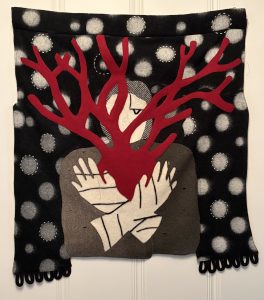
Holding My Heart. Jean Cacicedo. Wool, dyed, stitched. 2026, 34”x38″
“It’s hard. The main thing,” Jean says, “is unpredictability.”
“The main thing is unpredictability — if and when you’re going to feel bad. Obviously after every meal, but there are other times as well. The lethargy. The physicality of it — kind of numb throughout the body. Exhausted. Balance issues when walking — I feel like I’m walking drunk, that’s why I have to sit a lot. I feel like I’m on display. Disconnected. Don’t feel right. Don’t feel sick. Not getting blood to your body — it feels like the walls closing in. It happens a lot. Feels like you’re going to faint even after getting ready for bed — but not every night.”
That description — precise, physical, disorienting — is what PAF actually feels like from the inside. No test captures it. No chart note records it.
The complexities of daily management (medications, fluid, sodium, activity, etc.) coupled with whatever other health problems one has can be overwhelming. For example, the effects of PAF on blood pressure and heart rate have, I believe, led to persistent atrial fibrillation (AF) and congestive heart failure (CHF).
Technical medical discussion paragraph: AF and CHF coupled with the exercise intolerance inherent in PAF create challenges in daily life and the work to improve physical conditioning. When CHF is paired with PAF there is a therapeutic conflict between the high sodium demands of PAF and the low sodium demands of CHF. There is also therapeutic conflict between the high fluid volumes needed in PAF and the lower fluid volumes needed in CHF. If this seems technical and complex, it is. The neurologist and cardiologist seem to find it so as well. In our “siloed” health care system the neurologist wants the cardiologist to deal with heart issues and the cardiologist wants the neurologist to deal with autonomic issues. However, these are inextricably bound together in the understanding pathophysiology of PAF. Teaching is minimal. The bottom line: I figure it all out.
The heat intolerance of PAF means that one literally cannot function in a hot climate or on a hot day in a cool climate.
Severe dry eyes require constant management.
The chronic constipation of PAF is complicated by occasional episodes of sudden, severe diarrhea.
When flying with PAF, respiratory distress may be experienced while the plane is ascending and descending. Thus flying is a fearful event. I just purchased an oxygen concentrator to use while flying and have exercises that may help. We will see.
As with other chronic illnesses, PAF affects the entire family; it is truly a family illness.
Invisible and unexplained
PAF is classified by the NIH as a rare or orphan disease. That rarity has consequences that go beyond statistics. Most physicians have little familiarity with it — and some seem to reason that if they haven’t heard of it, it probably isn’t serious. Emergency personnel are largely unaware. Some know something about the more common dysautonomia POTS (postural orthostatic tachycardia syndrome), but PAF is less common and less recognized. Friends and family don’t understand what’s wrong, and explaining it soon runs into blank looks.
The institutional consequences can be surreal. My HMO refuses to include PAF in my chart’s problem list, on the grounds that PAF does not appear in the ICD-10, the World Health Organization’s International Classification of Diseases. No code, no diagnosis. Never mind that the condition exists and requires active management. The problem list is precisely what emergency personnel read first when a patient comes in unable to speak for themselves.
I live with moral injury related to the injustice of medical dependence on a system and individual doctors that will not give me the diagnosis that I live with and the collaborative health care I need.
The work of it
Managing a complex, dynamic chronic illness is genuinely demanding. Symptoms shift hour to hour, day to day, week to week. Staying ahead of them requires attention, discipline, and knowledge that most patients have to acquire largely on their own.
I’ve been fortunate to see an out-of-network autonomic specialist once a year. The Facebook PAF group provides information and community, and coordinates a biweekly Zoom support meeting — often with a prominent autonomic specialist in attendance. These are the resources that actually help. My HMO provides neither education nor support for this condition.
The social calculus
PAF quietly reshapes ordinary life. The postprandial BP drop means that walking to the car after lunch out is an effort requiring calculation. Sitting around the table after dinner becomes difficult. A museum is best taken in small increments, with a rollator — a wheeled walker — as an essential tool. Socializing requires planning that healthy people never think about.
And then there is the gap between appearance and reality. People assume that if you look fine, you are fine. You may look great. You may not feel great. That gap — between the face you present and the body you’re managing — is one of the quiet costs of living with PAF.
Finally
Having PAF is hard, stressful. I’ve experienced almost everything we’ve written about in this guide, except for phenoconversion and some of the testing. I am grateful to my autonomic specialist consultant, to friends and family who have stayed with me, to doctors who have tried to understand and help, and to the PAF Facebook group.
We, Charles and Jean, are grateful for one another.
This guide is for general educational purposes only and is not a substitute for professional medical advice. Always consult your physician regarding your specific condition, medications, or treatment. Medical information changes frequently; verify drug names, dosages, and current guidance independently. The authors disclaim liability for any injury or damage arising from use of this information.