Olongapo!

In 1966 I was in a special landing force (SLF) on the USS Vancouver, a “landing platform dock“ ship on the way to Vietnam. The ship had a cavernous bay (the dock) with the entire stern being giant doors that opened out into the water. LVTs (landing vehicles tracked) were parked inside and when ready for a landing could drive down a ramp into the ocean and then to shore. There were around 500 Marines in our unit and I’m guessing there were 30-40 LVTs inside the bay. When the LVTs were starting up it was a huge roar and smoke

USS Vancouver

everywhere inside the bay and we were lining up to climb inside ready to go into the water and to the beachhead. Topside there was a landing platform from which several helicopters could take off or land at the same time.

After an uneventful voyage from San Diego to Pearl Harbor and on to the Philippine Islands we docked at the Navy Base Subic Bay on Luzon. I think we were there for about a week the first time we were there and after a few weeks in Vietnam we went back to Subic for an unexpected 10 days. Most nights we went on liberty from the ship to the base and from there into the town of Olongapo, or at least to Magsaysay Street, the one street in Olongapo that wasn’t off-limits to Marines

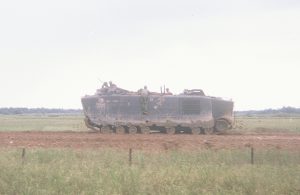
LVT. You can see a Marine hanging off the side and a driver up-front

and sailors. The street was 8-10 blocks long and was mostly bars, cafes, hour hotels, and the like.

Somewhere in there we made a practice landing on the island of Mindoro. When we hit the beach there were islanders selling orange sodas and good, heavy knives that were better than machetes for cutting your way through jungle and brush. Some of us traded ammunition for the knives. We practiced tactical movement in the jungle on the mountains in the rain. It was challenging, but not as challenging as combat.

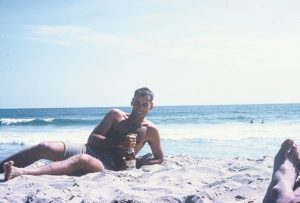
Liberty on a beach in the Philippines or Vietnam

At the gangway from the ship there would be a Marine and a sailor who would look you over to be sure you were squared away enough to leave the ship. At the time we were required to wear tropical khaki uniforms ashore instead of utilities (like “fatigues”). We were there during monsoon, so it wasn’t easy to keep clean uniforms. When it was raining we would wear a raincoat with trousers clean and pressed from the knee down; everything else would be wrinkled and even muddy or moldy. But that was good enough to get us off the ship. We would ride from ship to shore in open landing craft, dock at the base, and then head either to the Enlisted Men’s Club for okay food at a good price or go straight on into Olongapo.

The base had an exit gate that opened onto a bridge over a very polluted river where Filipino boys swam and shouted for coins. When you’d toss coins into the water they would dive for them. Just past the bridge the party for doomed youth began. Bars were usually segregated according to service, interests, or race – some were for sailors and some for Marines; some for country music and some for rock and roll; and some were for white guys and some for black guys. Going to the wrong bar could end up in a fight, but that could lead to arrest by the Shore Patrol and a night in the brig and no more liberty so actually everyone was pretty well-behaved for drunken Marines and sailors. Most bars had bar-girls or prostitutes who could be taken out to a hotel after paying the mama-san, the older woman who managed the girls. Payment for sex was separate and between the girl and her customer. Most bars had a sign demanding that guns be checked.

The only time I went off Magsaysay Street was when some of us took a jeepney to a brothel in another part of town. Part way through the party there was a raid by the Shore Patrol and we had to run for it. As we ran through the gate to the brothel one of the guys hit his head on an iron overhead – Bong! – and was staggering around confused and had to be pulled into the escape jeepney for a wild ride back to the legal part of town.

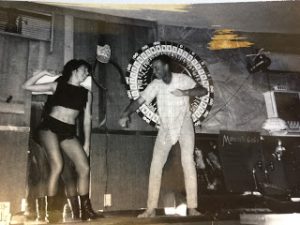
Photo in a bar in Tijuana, but it captures the vibe

I met a sweet-natured woman named Delia. We spent time in the bar where she worked, in cafes, and in a hotel. I remember once she coughed and spit it out on the floor of the bar, but I didn’t care. It was an intense time, especially the second time we were at Subic, since we had already spent a few weeks in VN, had been blooded, and so really knew what the score was. The “score” was that this was very serious business and some of us would be killed.

At the DMZ where we ended up

I ran out of money and had to make some to keep going into Olongapo. One of the guys in my company had already seen enough combat for his taste and was trying to avoid going back in. He and I worked out a deal for him to pay me to break his trigger finger. He laid his finger on a step on a companionway (like a ladder) and I hit it with an iron bar. It didn’t hurt as much as he expected and he said something like, “You didn’t do it!” and I said, “Look at it.” He did and he saw that the finger was going sideways and bleeding. I got my money and he got out of going back to VN. I recall that a few weeks later after we’d taken some serious casualties he pretended to try to get on a helicopter going from the ship to the field and was restrained by someone – phony drama. I’m glad I did it: we got rid of a quitter and I went to town. My guess is when he got out of the Corps he presented himself as a badass combat veteran haunted by the war.

For awhile my ambition was to own a bar in Olongapo or Tijuana or someplace like that. There would be prostitutes working there (but no cribs) and I would have my office on a balcony overlooking the blue-lit bar and I would sit up there drinking gin and tonics with my girlfriend.

———————————-

Just following orders: For Senator Mark Kelly

Just not following orders. 

“I was just following orders.”  It didn’t work for the nazis and in the end it won’t work for Trump’s minions. Here is an account of not following orders that somehow became something bigger than a brief altercation. I don’t think it was an unlawful order or even that big a deal, but when it was over I realized we’d been playing for higher stakes than I thought – my soul. What follows is taken directly from my blog post, Vietnam 66-67, Part 2: Hill 55, Dodge City.

The point is to affirm that decisions and actions can have positive and/or negative consequences.

Standing with Senator Kelly 

***

It never occurred to me that I would write this. It was something to keep secret and inside me forever; something to take out now and then, turning it over in my mind like the treasure it is (to me, anyway). I told Jeff a few years ago, but he already knew about it, even though he was not on that patrol.

We were on a long patrol – past even Dodge City. It had been raining for several days or maybe several weeks. I had this raincoat that was far superior to a poncho. I doubt many people ever wore a poncho past their first gunfight with one of those awkward things in the way of everything – I loved my raincoat. We were 3-4 days out, in an area we’d not seen before. We came to a ville (village) and moved around and through it. The plan was to round up everyone in the ville and search the place and people for weapons.

I came to a hooch (hut) with a bunker (all the hooches had bunkers in that neighborhood) and inside the bunker were several women and some children. The interesting thing was that one of the women was wet – even her hair, which told me pretty clearly that she had been doing something in a hurry before we got into the ville, i.e., she was VC. The other woman was holding a baby and the baby was crying, the thin, weak cry of a very sick baby.

I was standing there looking at them and it was like I could see myself as they saw me. I was death – unshaven, dirty death. The only clean thing about me was my machine-gun and

 it was immaculate. The gun oiled, every round in the 200-round belt perfectly cleaned, inspected – all truly perfect. I was looking at them and they were looking at me.

I was thinking, screw this. I’m not going to jack with these people. So I just stayed there, watching them. I had decided not to force them out, but not wanting to be killed, would never have taken my eyes off them. So we’re there, they, no doubt wondering what is going to happen and me, just very comfortable with my decision. At some point I tossed a couple of cans of C-ration ham or whatever into the bunker. They probably thought I was tossing grenades – they never touched the cans.

Then trouble. The lieutenant running the patrol came over and the interaction went something like this:

“Get those people out of there.”

“There’s a sick baby in there.”

“I don’t give a shit. Get them out of there.”

“There’s a sick baby in there.”

“I said, get them out, now.”

I was thinking, I guess I’m going to have to kill him, but he read my eyes and saw what I was thinking before I could act and he pointed his rifle in my direction (he always carried an M1 carbine, a silly weapon for which I had only contempt – but, an M1 pointed at someone trumps an M60 in the other direction, if you know what I mean) and there was nothing I could do because my weapon was already pointed pretty much down and to the left. Even though I was a lot better gunfight-wise than this guy, there was just no way I could get to him faster than he could get to me.

“I’m giving you an order, Marine. Get those goddam mother-fucking people out of there right now!”

Then two things happened.

The Big Hair (Harris) was off to the side and he put his weapon on the lieutenant and said something like, “Be careful, lieutenant.” Whew, what a relief. Then, the people in the bunker started coming out! The lieutenant walked off muttering threats. Harris smiled at me. “Yeah, man – fuckin’-A.” When the woman carrying the baby came out in the rain I stopped her and I took off my raincoat and gave it to her. She had no clue what that was about so I had to drape it over her. It was like the coat of a giant to her. Ridiculous.

I remember leaving the ville with all those people standing there in the rain and that sad-sack woman with her sick baby standing there with my raincoat dragging the ground.

Redemption song. Making a choice. I chose Life.

Checklist for preparing for incidents and crises (from Finland)

This document is copied from one sent to every household in Finland. Because of their proximity to Russia, Norway and Sweden are also doing this. But we have our own sources of disruption and this a good tool for thinking and planning. Among the differences between this document and similar ones is that this one addresses issues such as functional capacity, hybrid influence activities, and cyber attacks. What a world! The last sentence in the document says something like: The competence and activities of individuals in community form the basis for society’s ability to act when something extraordinary happens.


This checklist contains the most important instructions on how to prepare for incidents and crises and how to act during different situations.

What is preparedness and why is it important?

Personal preparedness

  • means preparing for different incidents, crises and emergency conditions
  • affects how well you, your loved ones and society will cope with an extraordinary situation
  • consists of home emergency supplies, knowledge, skills, functional capacity and a sense of community
  • does not mean that you think something bad will happen.

How are incidents reflected in day-to-day life?

Incidents are situations in which the vital functions and services of society do not function as usual.

Lengthy incidents affecting large areas particularly interfere with the normal functioning of people’s everyday lives and society.

Incidents include:

  • power cut
  • water outage or water contamination
  • disruptions in communications infrastructure
  • disruptions in payment and banking services.

Basic knowledge and skills help you cope with many situations

You will cope with many situations when you:

  • Stay calm.
  • Think about what the situation involves and which instructions you know are related to it. How does the situation affect you, your loved ones and the people local to you?
  • Follow official communications and emergency warnings.
  • Follow the instructions.
  • List the most important things to do in the situation and take action.
  • Help others to the best of your ability.

Home emergency supplies checklist

Home emergency supplies checklist:

  • bottled water and clean containers with lids for storing water
  • ready-to-eat and easy-to-cook foods that you use in your regular everyday life
  • radio operating on batteries or otherwise without mains electricity
  • a flashlight or some other lamp operating on batteries or otherwise without mains power
  • a charged backup power supply
  • essential medicines that last you a little longer
  • iodine tablets if there is someone in your household in the target group for the iodine recommendation (people at most 40 years old, pregnant or breastfeeding)
  • hygiene supplies that allow you to stay clean without water
  • a small amount of cash (different denominations)
  • duct tape for sealing windows and vents
  • also enough food and water for your pets

Also remember the following:

  • Get sufficient knowledge and competence.
  • Do not lose your head when getting the supplies if there is an incident.

Read more about home emergency supplies

Pay attention to functional capacity in preparedness

Learn aspects can affect functional capacity. These may include ageing, disability or illness.

Use the following questions to think about which arrangements enable your or your loved one’s preparedness:

  • How will the incidents specifically affect your everyday life?
  • What restrictions should be taken into account?
  • What can you do yourself and where do you need help from others in various situations?
  • Who could help you the quickest if something happened?
  • Should you improve your safety net?

Hybrid influence activities may cause disruptions

Hybrid influencing refers to harmful activities involving a wide range of methods which foreign states use to cause a detrimental effect on the target country.

For people, hybrid influence activities usually manifest as ordinary disruptions, such as service interruptions, or they may not be visible at all. If hybrid influencing succeeds, it may manifest itself in people’s lives, for example, as a loss of trust or an increase in fears and polarisation.

You do not have to separately prepare for hybrid influencing as such, but rather make sure you are prepared for incidents.

Information influence activities undermine the functioning of society

Information influence activities refer to harmful activities involving a wide range of methods, typically conducted by a state actor. The aim is for people or society to act against their own interests.

A person sharing their views or official communications are not examples of information influencing.

Read more about information influence activities

Protect yourself against disinformation and information influence activities

In protecting yourself against disinformation and information influence activities, it is important to

  • identify the topics through which it can be the easiest to appeal to your thinking and emotions
  • identify how situations and issues affect your feelings and thoughts.

Think about

  • which issues cause concern or stir strong emotions in you or scare you, for example
  • how you regard incidents that upset or anger you and what kind of behaviour do they cause in you
  • does the way you look for information during a crisis support or reduce your wellbeing
  • what cognitive biases may affect the way you receive and process new information.

Look for more detailed instructions for protecting yourself against disinformation and information influence activities

Do not provide visibility for false information

  • Check where the information originated.
  • Do not share any information you are not certain about.
  • Base your assessment of reliability on the facts of the content.
  • Do not share content that you know to contain incorrect information.
  • Think about why a discussion is occurring before reacting to content.

What are epidemics and pandemics?

An epidemic refers to a situation where a communicable disease occurs more than normally in the people of a certain area.

A pandemic is a situation in which an epidemic spreads geographically over a large area, for example across continents.

Can I prepare for pandemics?

To prepare for a serious health threat, it is a good idea to know how it could affect your everyday life. Each pandemic situation is unique and requires appropriate measures.

The authorities will tell you if you need to take special measures due to the disease situation.

Do this in the event of a pandemic

The most important thing is to follow the instructions and recommendations of the authorities and healthcare.

The best way to prevent the spread of infectious diseases and people falling ill is by ensuring good hygiene and vaccinations.

What are cyberattacks and cyber incidents?

Society depends on information systems. Related disruptions therefore have a great impact on the functioning of society and everyone’s day-to-day life. During an incident or attack, the services do not function normally.

Attacks on organisations or societal functions are particularly prone to cause extensive incidents.

Prepare for cyberattacks

Be prepared that cyberattacks may affect your everyday life:

  • your network and telephone connections may be interrupted and power may be cut
  • card payment and online banking services may be disabled
  • official services or websites cannot be accessed.

You should also be aware of the risk of data breaches and leaks. It is important that you protect your data well.

See more detailed instructions on preparing for cyberattacks

Protect yourself against cyberattacks

  • Make sure that your accounts and services have strong passwords and use multi-factor authentication.
  • Install device updates and protect your devices against viruses, for example.
  • Use several electronic identification devices.
  • Act securely in online services and also pay attention to information security at the workplace.

See more detailed instructions on how to protect yourself against cyberattacks

What are natural phenomena and major accidents?

Natural phenomena and major accidents include:

  • storms and floods
  • wildfires and major building fires
  • accidents involving dangerous substances
  • radiation hazards
  • other high-risk unforeseen events.

How people are alerted of the hazards

Approaches for issuing immediate hazard warnings include:

  • Emergency warning
  • General alarm signal

Early warnings may be given of weather phenomena that pose a significant risk, such as storms. This helps prepare for them and therefore reduces the damage caused.

Why should you prepare for storms and floods?

During a storm, strong winds and especially gusts of wind cause damage.

Flood water can cause damage as the water rises in a built-up area due to sudden heavy rainfall, rising sea levels on the coast or rapid melting of snow cover.

Prepare for storms and floods

Storms:

  • Follow the weather reports and warnings in your area.
  • Think about the risks that may arise in your environment during a storm and use this as the basis for preparing.
  • Take precautions by having home emergency supplies and necessary goods.

See more detailed instructions on preparing for storms

Floods:

  • Find out if you live in a flood hazard area or if an urban flood can affect your residential area.
  • Follow the weather reports and warnings in your area.
  • Take precautions by having home emergency supplies and necessary goods.

See more detailed instructions on preparing for floods

Do this during a storm or a flood

Storms:

  • Stay indoors.
  • Follow the communications of the rescue department in your area.
  • Do not call the emergency number unless the storm poses an immediate risk of accident or death.

See more detailed instructions on what to do during a storm

Floods:

  • Protect your assets from flood damage.
  • Make sure you are safe: do not go to flooded areas or enter flood water.
  • Follow the instructions given by the rescue department and the authorities in your area.
  • Move away from the area or go to the upper floors of your building.

See more detailed instructions on what to do during a flood

Why should you prepare for wildfires and building fires?

Fires can pose a major risk to life, health and property. Toxic combustion gases pose the greatest threat to health.

You can prevent the risk of fire through your actions:

  • Exercise caution whenever handling fire and using electrical appliances.
  • Identify potentially hazardous situations and take risks into account.

Prevent and prepare for wildfires and building fires

  • Wherever you are, make sure your behaviour does not pose a risk of fire.
  • Be careful whenever dealing with live fire.
  • Do not light a fire if there is any risk that it may get out of control.

Do these:

  • Make sure your smoke detectors are in order.
  • Learn first-aid extinguishing skills.

Follow these steps if you notice a fire

  • Report the fire to the emergency number 112.
  • Try to extinguish the fire if it can be safely done.
  • Warn and help others and save yourself.

Remember that breathing combustion gases is dangerous.

See more detailed instructions:

The spreading of hazardous materials into the environment

Hazardous materials could end up in the environment because of an accident, for example. Chemical substances can cause a variety of symptoms.

Remember that it is often impossible to identify hazardous materials based on your senses. If there is a warning of hazardous material, follow the instructions given by the authorities even if you do not notice the hazard.

Do this if a hazardous substance is spreading to the environment

If hazardous material is spreading in the area, a general alarm signal and an emergency warning are used to warn people.

  • Seek shelter indoors and stay indoors until you are informed that the threat is over.
  • Follow the instructions given by the authorities in emergency warnings.

If you are in a location where a presumably hazardous substance is being released into the environment:

  • Protect your respiratory tracts and walk away from the area.
  • Call 112 for help.
  • Follow the instructions given by the authorities.

Radiation hazard

Situations involving radiation hazards may include:

  • a serious accident at a nuclear power plant in Finland or in nearby areas
  • an accident in the transport of radioactive material
  • the use of a nuclear weapon in Finland or nearby areas.

The release of radioactive material into the environment depends on what has happened and the weather in the area.

If a radiation hazard occurs, the rescue department in your area will inform you with an emergency warning and give instructions.

How to prepare for a situation involving a radiation hazard

  • Learn how to seek shelter indoors with your loved ones.
  • Know the alarm methods: an alarm signal and an emergency warning are used to warn people of the radiation hazard.
  • Know which communication channels are used: the 112 application, television, radio and the websites of the authorities.
  • Know the authorities providing instructions: rescue department in your area, Radiation and Nuclear Safety Authority (STUK).
  • Buy medicine iodine tablets at home according to the recommendation.

In the event of a radiation hazard

If there is a radiation hazard in the area, a general alarm signal and an emergency warning are used to inform people.

If this happens, do as follows:

  • Seek shelter indoors and stay indoors until you are informed that the threat is over.
  • See and follow the instructions given by the authorities in emergency warnings.

Seeking shelter indoors

Learn how to seek shelter indoors with your loved ones.

Follow these steps if you hear the general alarm signal or the emergency warning prompts you to seek shelter indoors:

  • Go inside your home or the nearest indoor space.
  • Follow the authorities’ emergency warnings and act according to their instructions.
  • Stop ventilation and seal any openings from which air can flow into the interior space.
  • Seek shelter indoors until the authority reports that the situation is over.

How do I prepare for disruptions in payment services?

Prepare for disruptions in payment services:

  • Keep a small amount of cash at home.
  • Prepare with home emergency supplies.
  • Have the cards of two different banks.
  • Use several strong identification methods.

See more detailed instructions on preparing for disruptions in payment and banking services

What should I do during a disruption in payment or banking services?

  • Follow the information provided by your bank about the situation.
  • Find out if you have cash or if some other method of payment works.
  • Use your home emergency supplies.

See more detailed instructions on what to do during disruptions in payment and banking services

Preparedness for military threats and civil defence

Preparedness and the maintenance of defence aim to create a preventive restraint to avoid a military threat to Finland. There are many ways to prevent threats and if threat prevention fails, any attacks will be countered by military defence.

Preparing for civil defence is a statutory task of the authorities. Civil defence means that civilians are protected from the effects of war and the conditions for survival and safeguarding society’s functional capacity are ensured.

National defence belongs to everyone

In the event of an armed attack on Finland, Finland would defend its region, population and society, making full use of its resources.

National defence includes

  • the capacity of civil society to act during emergency conditions
  • armed defence
  • the duties of persons liable for non-military service
  • voluntary defence.

The national defence obligation applies to all persons aged 18 or over but under the age of 68 living in Finland. They could be assigned tasks according to each person’s abilities.

Civil defence shelters and evacuation

Civil defence shelters are prepared for use and used to seek shelter if so ordered by the rescue authorities.

Find out about the practices for seeking shelter in a civil defence shelter that apply to you from

  • your housing company’s rescue plan
  • your workplace’s emergency plan
  • your municipality’s services.

Read more about sheltering in civil defence shelters

Evacuation is not always necessary even in war conditions.

  • Evacuation is carried out if other civil defence measures are insufficient for protection.
  • The authorities will provide information and instructions if it is necessary to leave the area.

Read more about evacuations

Your role during a military conflict

  • In the event of a war, conscripts who have completed military service and persons liable for non-military service would carry out their duties in accordance with their training and competence.
  • Civilians would have more responsibility for maintaining the functioning of society, and they would be obliged to participate in tasks that meet their abilities.

Read more about what your role would be during a military conflict

Prepare for long power cuts

  • Prepare with home emergency supplies.
  • Learn the skills you would need to operate without electricity.
  • Get a lamp that runs on batteries or without mains power.

Access to information:

  • Enable your power grid company’s disruption notifications for your area if available.
  • Make sure that you know how to get information about the situation during a prolonged power cut. In the event of a prolonged power cut, the telecommunications and mobile networks will cease to function.
  • Get a radio that runs on batteries or without mains power.
  • Discuss with your loved ones what to do if you cannot contact each other.

See more detailed instructions on preparing for power cuts

Do this during a power cut

  • Switch off electrical appliances, especially any heat-generating devices.
  • If there is water coming from the tap, collect it into a clean container.
  • Do not pour water down the drain or flush the toilet.
  • Think about how can keep warm at home.

When the power cut ends:

  • Do not start all electrical devices at once.
  • Check that no heat-generating appliances are switched on unless used as they pose a fire hazard.

See more detailed instructions on what to do during a power cut

Terrorism causes fear and a lack of security

  • Terrorism aims to create fear and make people feel unsafe.
  • The authorities work together to prevent acts by addressing the root causes of terrorism.
  • The Finnish Security Intelligence Service is constantly monitoring threats.

Do this if you are the victim of a life-threatening attack or a terrorist attack

  1. If you can, get away.
  2. If you cannot escape, hide and seek shelter.
  3. If you are in a safe place, call 112 for help.

Prepare for disruptions in communications infrastructure

  • Enable your network and telephone operator’s disruption messaging services.
  • Save the customer helpline number.
  • Get a radio that runs on batteries or without mains power.
  • Discuss with your loved ones what to do if you cannot contact each other.

See more detailed instructions on preparing for disruptions in communications infrastructure 

Do this if network and telephone connections do not work

  • If possible, check for information about the incident either on your operator’s website or customer service by telephone.
  • See your operator’s communications about the situation.
  • The authorities provide information on serious incidents on YLE’s channels if other communication channels do not work.

See more detailed instructions on what to do during disruptions in communications infrastructure 

Prepare for water cuts and water contamination

  • Prepare with home emergency supplies and enough drinking water.
  • Reserve clean containers with lids for water.
  • Enable your water company’s disruption notifications for your area if available.
  • Think about how you would take care of your hygiene without water and prepare based on your needs.

See more detailed instructions on preparing for water outages

Do this when water is out or contaminated

  • Follow the communications of your local water utility and municipality.
  • If the water has been contaminated, the authorities may provide information about the situation using emergency warnings and official information.
  • Use the water you have reserved in your home emergency supplies as your drinking water and take care of your hygiene using the supplies reserved for this purpose.
  • Share information about the instructions issued by the authorities and help your loved ones and those living nearby.

When the water outage ends:

  • Follow the instructions issued by the water utility and the municipality.
  • Run the taps to clean your pipes.

For more detailed instructions, see: 

You can prepare for difficult situations

Think about

  • how you might react to a crisis?
  • which positive actions have previously made you feel better in difficult situations?
  • which activities and entertainment could help you keep your spirits up?
  • would you or one of your neighbours or loved ones need support or help?
  • which services of your municipality and organisations could you contact for help and support?

Read more about coping during a crisis

False information impairs functional capacity

False information and information influence activities may impair your coping and affect your functional capacity.

  • Distance yourself from the incident and the flood of information if you feel stressed by the situation.
  • Consider whether the amount of information you are exposed to or your media habits support or impair your coping and mental wellbeing.
  • Assess how much you may be exposed to false or misleading information and attempts to manipulate your emotions.

Get help and support if you are struggling

Different parties provide online, telephone and face-to-face counselling. A helpline may provide you with advice on who to contact.

Support providers include

  • healthcare and social welfare
  • church and other religious communities
  • non-governmental organisations.

See more detailed instructions for seeking help

Help and participate

You can help improve the collective ability to cope in extraordinary and difficult situations.

  • Learn skills that help you and others. Different parties offer training in areas such as first aid, first-aid firefighting, preparedness and national defence.
  • Participate in volunteering. As a volunteer, you can contribute to building a sense of community, help others and participate in rescue tasks, for example, during an extraordinary situation.
  • Build a sense of community: participate in joint activities and discussions in your neighbourhood, village, workplace and other groups in your area.
  • Be prepared to help others. Children and young people, the elderly or other special groups in particular may need support during extraordinary situations.

Read more about how you can help and participate

Safety and a stable society are part of preparedness

When preparing for crises, it is important that people

  • trust their own and society’s ability to protect themselves from threats, act in crisis situations and recover from them
  • feel that they can influence how safety is achieved for everyone in their living environment
  • maintain trust in other people and are prepared to support others
  • participate in constructive dialogue with others and democratic decision-making.

Do this in an emergency

  • Call the emergency number 112.
  • Listen and answer the questions asked of you.
  • Follow the instructions given by the emergency response centre operator.

Only call the emergency number in urgent emergencies.

Everyone is obliged to help

Remember that

  • everyone has a duty to help if someone is in danger
  • a person in need of help may not ask for your help
  • just because someone else is already helping the person does not relieve others present of their responsibility to help
  • failure to help is a punishable act.

Preparedness in housing companies

Housing companies must prepare for various incidents and crises.

Safety:

  • the building has an up-to-date rescue plan
  • residents know their responsibilities
  • residents are familiar with safety instructions and know how to follow them.

If the housing company has a civil defence shelter:

  • it is properly maintained and has the necessary equipment
  • the shelter can be commissioned within 72 hours on the order of the rescue authority
  • the building residents know how to prepare the shelter for use.

Read more about preparedness in housing companies

Comprehensive security is about cooperation between different operators

Different parties in society cooperate in preparing for and acting during incidents and crises, for example by maintaining the security of supply and assessing risks.

These include:

  • national, regional and local authorities
  • companies and employers
  • organisations and religious communities.

The day-to-day activities of the police and rescue services also lay the foundation for acting during incidents and crises.

The competence and activities of individuals form the basis for society’s ability to act when something extraordinary happens.
VA follies

In August 2023 I applied for VA benefits. I had three goals:

  • Y’all take your time

    Be registered for VA healthcare.

  • Receive a determination on disability related to combat.
  • Have my discharge papers (DD214) corrected so that all awards are shown on the document.

One by one the goals were achieved – after many communications back and forth, consultations with veterans service officers at the Alameda County welfare department, examinations by VA medical staff, support from Jean, Leslie, David, and Jeff, and finally, after interventions by my Congressperson and by the Sergeant-Major of the Marine Corps. All goals were finally achieved last week. 15 months. I realize I’ve posted about this before. This one is happiness and a little more info.


Random – VA, dog park, battlefield, dream

Water’s Edge, Jean Cacicedo, 1980s. From Chris Scott’s collection

I was in the crosswalk crossing a busy street when a car blew past me – not dangerously close, but too close. I shook my cane at him. I thought what a picture I must be, 80 years old shaking my cane at some guy already a block away. That’ll teach him!

Today I went for a walk at Point Isabel on the SF Bay. Cool ocean breeze blowing across the bay, listening to Van Morrison singing, “Oh the water, oh the water… and it stoned me to my soul.” We had a picnic in the van parked beside the bay, at the miles-long dog park, and San Francisco in the foggy distance (the bridge completely obscured with foggy clouds, but you can still see Alcatraz). The dog park is so big there’s just a few dogs around, including one doing little tricks with a woman. It seems to us that almost everyone you encounter at this place is nice to encounter. After lunch we took a nap on the actually very comfortable van bed. Jean was in the sun. We both slept well.

Montana

The VA has come through for me. I’m a partly disabled American veteran. I’m registered at the Oakland VA clinic. I drove over there to register for care, which was easy. It just took me 13 months to get here. It was like what you might expect at an Oakland VA facility at the edge of downtown. In terms of demographics most of the patients I saw were older Black men. Then Latinos, then White. People were friendly and there seemed to be a lot of respect happening.

The VA claimed that I said I didn’t complain about any injuries before now because “he didn’t want to jeopardize his career.” Laugh my ass off! A career as a corporal in the infantry. There’s a career for you! What I told the examiner was that I didn’t complain because I was a warrior and complaining isn’t part of warrior culture. Unless you’re complaining about the Marine Corps or the VA.

Early morning San Francisco Bay

They finally looked at my entire personnel record and saw documentation of all awards, including those not listed on my discharge papers. I could have had the discharge papers corrected 50+ years ago, but I would have had to stay in the Corps another week or so and more than anything else I wanted out. As long as you’re in they own you. Goodnight, Chesty, wherever you are.

We went out west to Montana and Wyoming a couple of weeks ago. We were in Bozeman, Red Lodge, Billings, and Sheridan. The high point for me was a long drive in the countryside with Courtney. We also visited the Little Big

CK, shortly after first Marine Corps haircut

Horn Battlefield where Custer and his troops were defeated. There are markers where the men were killed – a hundred or more in one place, ten in another, two in another, five or six in another. A bad, lonely way to die.

The election is over. The dream is over – one that started well before Kamala Harris.

10 years ago, a few days in Vietnam

2013 was a great year, 2014 was a hard year, 2015 was impossible

Two friends were here for dinner yesterday evening. At some point we began talking about what we were doing 10 years ago. Not surprisingly, there had been changes and losses for all of us. Here is a partial account of what I didn’t say.

There was music at the party

10 years ago on New Years Eve of 2014 I was at a gathering with other members of the Atrium Obscurum crew, the people I worked with to put on forest psytrance events. It was an all-night psychedelic party, with most people tripping and others rolling. At some point we gathered around a firepit behind the house and had one of those ceremonies where everyone writes on a piece of paper something they want to let go of from the past year and then one by one, say a few words, and toss that burden into the fire. When it was my turn I said that 2013 was one of the best years of my life and I had nothing to unburden myself of. I said I hoped 2014 would be as good.

A few months into 2014 Leslie began to decline and 2014 got harder and harder and harder until in March of 2015 she passed away. Then the grief. Late 2014 and into 2015 was one of the two hardest times of my life, the other being my 13 months in Vietnam. Below is brief description of a couple of days in Vietnam.

2024 is unfolding as a good year.

———————

At the “The Hill Fights: The First Battle of Khe Sanh”

I came in with another man on a helicopter to link up with B/1/9 (B Company, 1st Battalion, 9th Marine Regiment) on an operation at the DMZ. When the helicopter came in to where B Co was in those dry hills, the LZ was getting hit with mortars. I didn’t know what was happening and it was a complete surprise when the chopper was about 10 feet off the ground and the crew chief put his boot in my back and pushed me out, followed by a rain of ammo, C-rations, etc. they were tossing off the chopper. There were a lot of mortars coming in, too and I made it to a little hole full of Marines. When I dove in on top of them some lieutenant was telling me to get the hell out and I was just burrowing into the pile, not going anywhere.

The next thing I remember was described in the book, “The Hill Fights” by Edward Murphy. Murphy is writing about someone named Montgomery:

I took this somewhere at the DMZ. They’re loading weapons left from KIAs and WIAs. Two men in foreground are WIA.

“Corporal Montgomery struggled with the heavy load his team carried as they sought cover. They had almost made it when a brace of mortar shells crashed behind them. The twin blasts threw Montgomery into the brush. When he came to a few minutes later, blood flowed from shrapnel wounds in his right thigh, right hand, left arm, left buttocks, and the right side of his neck.

He says, ‘I looked around. No one else was there.’ Mortar shells were still exploding along the ridgeline… I was afraid I’d been out for a while and had been overlooked in a withdrawal, so I crawled on all fours to a nearby bomb crater. I hurt too bad to go any further, so I started calling for help.’

Two marines hiding in another crater answered. As soon as I told them that I was wounded they crawled over and patched me up. ‘Where is everybody?’ Montgomery asked. ‘Where did they go? Are they all right?’ The two marines told him what they knew which was not much, then Montgomery asked them for a favor. Montgomery pulled a camera from his pack and handed it to one of the men, and with mortar shells crashing behind them the man took Montgomery’s picture. ‘What a souvenir that’ll make,’ he thought. As soon as the mortars stopped Montgomery’s two new friends helped him back to the main body.

(I was the man who took Montgomery’s photo. He was sitting in the dirt in the crater, very bloody, smiling, shooting me the finger.)

Minutes later without a word everyone began to move out. The few remaining able-bodied Marines grabbed the wounded and dead and started humping. The men moved with a single-minded goal: get out of the killing zone. The NVA was not going to let that happen.

About ten men made it safely over the ridgeline before the mortars came again. In rapid succession more than a dozen high explosive shells wracked the column. Marines dove left and right seeking cover on the barren hillside. Still, chunks of hot metal found flesh. Up and down the column men were crying out in pain. Some were wounded for the second time that day. More than half a dozen were also freshly wounded and desperate cries of, ‘Corpsman!’ ‘Corpsman up!’ echoed across the hillside. This attack pushed B/1/9 to its limit. They were burdened with more casualties than they could carry, without food for two days, with little water, low on ammo, and without any prospect of evading the enemy. Some in the unit saw no sense in continuing this way. The ambulatory and uninjured might make it to Khe Sanh if the dead and the badly wounded were left behind. Captain Sayers never considered this. Bravo company would succeed or fail as a unit. That was the way it was. There were no other options. The survivors would sell their lives for a high price, taking as many enemy with them as they could.” END QUOTE

Somewhere on the barren hillside, not far up the trail, we got the wounded man to safety. There was a depression in the trail and there were people tending to a another wounded Marine there. He was dying and they were trying to save him, but when they turned him over some of his insides fell out of his back and he died.

In thinking about this I’ve never been able to remember where the trail finally went. Now I know. Farther up the trail a few helicopters came to take out the last casualties and by the time they got to the dead men, there was extra room on the last chopper. So I got out safely and B/1/9 was linked with K/3/9 (K Co., 3rd Bn, 9th Marine Regiment).  

In November 2009 I wrote about what happened with me next:

After it was over, 1/9 Marines carrying the dead

(11/2009) I was flying out of an operation, in a chopper with a lot of weapons and several bodies. We were flying low, coming up on any enemy too fast for them to hit us except they did, bullets banging into the chopper and it started spinning except the pilot flared it some and though we slammed hard into the ground. It wasn’t a disaster – except for the fact that we had just been shot down by people with bad intent who were undoubtedly headed our way from not very far away. We set up some guns and in just a few minutes we began to take a little fire and then another chopper got there and we dragged the bodies to the other chopper and got out of there (calling in artillery fire on the downed chopper).

——————-

Writing this has been a comfort to me. It doesn’t really bother me much anymore. It’s crazy to think that these things and more happened. The comfort I take is related to the war in Ukraine. I’ve been worrying about the Ukrainian soldiers who are going through heavier combat than I ever did. How can they process it later in life? As I reread the above, I think that if I’m OK, maybe some of them can be, too.

——————-

I read all this to Jean. I am thankful to her for hearing it.

A bunch of names (Vietnam Veterans Memorial)

My friend, George Schools (who fought on Grenada), sent me this from his blog, My Name is Schools. Deeply touched barely touches my internal response. Thank you, George. (I added captions to George’s photos).

A BUNCH OF NAMES

Dear Charles,

The war is over

I hesitated to send you this, but you’ve written about your experiences in Vietnam, and talked specifically about Dwight Laws (KIA 10/30/66), Lurch Donohue (KIA 03/01/67), and Jerry Georges (KIA 03/23/67) in your blog https://ckjournal.com/first-post-vietnam. I’ve read these posts uncounted times, and I probably will continue to until I die.  Everybody should.  Still, they are your memories, and that is your life, and I didn’t want to overstep the bounds.

I just returned from a family vacation to Washington, DC.  You know my family, and you know me pretty well, I think, so you know that means that when we’d seen all the sights their patience could contain, I went off on my own.  I didn’t know if you’d ever been to DC and the Vietnam Memorial, or if that was something that even interested you.  In fact, I wondered if perhaps that was something you had decided you did not want to do.  So here’s the part where I tell you to just delete all this right now, and tell me to erase it all from my hard drive if you want.  I’m totally ok with that.  They are your memories, and that is your life.

So from this point on, here’s what happened:  I knew I wanted to visit the Wall.  I knew I wanted to find the names of Dwight Laws, Lurch Donohue, and Jerry Georges and send them to you.  And I knew I needed to be there alone, even though I never knew them, the war was over two years before I graduated high school, and they were just names to me.  Three names among 58,307 names of dead Americans.  But I was thinking I could find the names of these people who are very real to you, and you are very real and alive to me, and that would help me understand what I was looking at.

Dwight Laws (whose wife’s name was Barbara Laws)

Like my own Greek chorus, as I’m scanning panel 11E130 for Dwight’s name, a family passes by and a kid says “it’s just a bunch of names!” There’s a Vietnam vet volunteer there explaining the war and the wall and the names to people, and I hear him say loudly enough for me to hear a couple of times “just ask if you need any help,” but I didn’t want any help.  And I finally figured out how to find Dwight’s name, and here it is:

After that, it was pretty easy to find Lurch’s name (which was actually Francis, so now we know why your friend went by “Lurch”), and finally Jerry Georges .

And as I’m looking at all these

Lurch Donohue

names, and trying very hard to think about Dwight, and Lurch, and Jerry, I still wasn’t making the connection I’d hoped.  It was still just a bunch of names:  fifty-eight thousand, three hundred and seven names of dead Americans.  And then it occurred to me that your name was not on that wall.  There was no Charles Kemp.  It could have been, probably should have been, but it wasn’t there.  And I knew you, very real and alive to me, and Dwight, Lurch, and Jerry were not.

Jerry Georges (from Santa Barbara, California)

Charles Kemp, father to David, husband and companion, neighbor, citizen. Very real.  Thank you for making the Wall so real to me by being alive.

_________

To George’s post, I added:

And now the war is over.

The main Vietnam War posts.