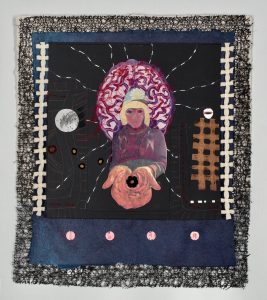
Dysautonomia Offering. Jean Cacicedo, 2024. Paper, cloth, stitched. 15″x15″x1/2″
PAF is rare, and many clinicians — including in emergency settings — have limited experience with it. This guide is designed to help you understand each aspect of your condition, monitor it at home, and take informed action. Bring it to appointments. The section on each problem includes what to tell clinicians who are unfamiliar with PAF.
1. Orthostatic Hypotension (OH)
Orthostatic hypotension — a drop in blood pressure upon standing — is the cardinal sign of PAF. It is present in virtually every patient and is usually the most disabling problem.
The problem
When you stand, gravity pulls blood into the legs and abdomen. A healthy autonomic system instantly tightens blood vessels and slightly raises heart rate to maintain pressure to the brain. In PAF, this reflex is absent or severely impaired. Blood pressure falls, sometimes dramatically, within seconds to minutes of standing. In some cases there is “impaired Valsalva maneuver,” i.e., a rapid and profound drop in BP after straining at stool or having a bowel movement.
What it feels like
- Lightheadedness, dizziness, or a sensation of “going gray” when standing
- Generalized weakness or heaviness in the legs
- Feeling vaguely unwell, foggy, or drained — especially after meals or in heat
- Blurred or tunneled vision
- Neck or shoulder ache (the “coat hanger” pattern) from poor perfusion to neck and shoulder muscles
- Symptoms that improve promptly when lying down
What can go wrong
- Fainting (syncope) and falls — with risk of injury
- Reduced blood flow to the brain over time, with potential for cognitive effects
- Supine hypertension: the same regulatory failure that causes low standing BP often causes dangerously high BP when lying down — treatment, including self-care, must balance both
- Labile BP: wide swings between high and low stress blood vessels and organs
- Post-meal (postprandial) hypotension: BP drops further after eating as blood shifts to the digestive tract
- Exercise intolerance: it is not just the heart and brain that are affected by OH. Muscles also need blood to function optimally.
Testing
Medical:
- Orthostatic vitals: BP and heart rate measured in three positions
- Protocol A (autonomic lab standard): 5 min supine → 1 min standing → 3 min standing
- Protocol B (some clinical settings): supine → seated 1–2 min → standing 1 min → standing 3 min
- A drop of ≥20 mmHg systolic or ≥10 mmHg diastolic confirms OH
- In PAF, heart rate does NOT rise significantly when BP drops — this distinguishes PAF from most other causes of OH and is an important clinical clue
- Tilt-table test: clinic-based; controlled reproduction of positional BP changes
- 24-hour ambulatory BP monitor: captures full day/night BP profile including supine hypertension
Home monitoring:
- Upper-arm validated BP cuff (not wrist)
- Measure after 5 min supine; after 1–2 min sitting; immediately on standing; at 3 min standing
- Keep a log: time, position, symptoms, meals, recent activity
- Morning pre-rising readings often capture the highest supine BP
Bring your log to appointments. Clinicians unfamiliar with PAF may not order orthostatic vitals routinely. A home log over days or weeks gives a far richer picture than a single office reading.
What you can do
Daily habits:
- Rise slowly: sit on the bed edge before standing; pause again before walking
- Avoid constipation and straining to have a bowel movement; allow for recovery after bowel movement
- Sodium: 6–10 g daily (your physician may set a different target)
- Fluids: 2–2.5 liters daily; 500 mL drunk rapidly before standing or arising from bed gives an acute BP boost
- Compression: waist-high stockings or abdominal binder — on before getting up
- Meals: small and frequent; limit simple carbohydrates
- Heat: avoid hot showers, baths, outdoor heat — all worsen OH
- Bed elevation: raise head of bed 10–20 degrees to reduce overnight fluid loss and moderate supine hypertension. Note that elevation is for entire torso vs. just an extra pillow
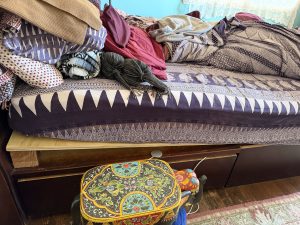
One means of elevating torso: 4×4 supporting piece of 3/4″ plywood at an angle. There are also mechanical head-elevators available from mattress retailers
- Physical countermeasures: leg crossing, tensing leg muscles, or squatting can temporarily raise BP when symptoms start
- When feeling unsteady or likely to feel unsteady, use a walker or rollator. Make a personal commitment to immediately sit down, even on a sidewalk, when feeling faint. Don’t worry about appearances.
Medications:
- Droxidopa (Northera): norepinephrine precursor; raises standing BP; first-line for PAF
- Midodrine: vasopressor; waking hours only — do not take within 4 hours of lying down
- Fludrocortisone: promotes sodium and fluid retention, raising blood volume
- Pyridostigmine: modest BP support with relatively less effect on supine hypertension
Note: medication changes should always involve your physician. The OH–supine hypertension balance is delicate.
Important note: maintaining optimal physical condition is helpful in maintaining maximum physical and mental well-being. This is true for anyone, and especially for people with PAF. A significant challenge in regular exercise is that decreased blood pressure means decreased blood perfusion into muscle tissue, i.e., the muscle machine of the body is running on less fuel. Water walking (walking in midriff/diaphragm or waist deep water) is a great way to exercise. I can walk for 45 minutes nonstop in water, but only for 10–15 minutes out of the water before falling BP exhausts me. Why does water walking work? There is just enough pressure from the water to prevent pooling of blood.
2. Supine Hypertension
Supine hypertension — high blood pressure when lying flat — occurs in the majority of PAF patients and is the flip side of orthostatic hypotension. The same failure to regulate vascular tone that causes BP to fall when standing allows it to rise unchecked when the body is horizontal.
The problem
When lying flat, blood no longer has to fight gravity to reach the brain. Without autonomic regulation to keep vessels appropriately relaxed, pressure builds. BP while supine can reach 160–200+ mmHg systolic in PAF patients — even patients whose standing BP is dangerously low.
What it feels like
- Often no obvious symptoms — supine hypertension can be silent
- Headache, especially at the back of the head, when lying down
- Nausea or a sense of pressure or fullness
- Nocturia (waking to urinate frequently) — the kidneys excrete excess fluid in response to high overnight BP
- Worsened morning OH: overnight pressure natriuresis (fluid loss through urine) reduces blood volume, making the standing BP drop worse the next morning
What can go wrong
- End-organ damage over time: heart, kidneys, and blood vessels are stressed by chronically elevated overnight BP
- Hypertensive crisis: very high BP (typically >180/120) can cause stroke, heart attack, or acute kidney injury
- The treatment paradox: medications that raise standing BP can worsen supine hypertension; this is the central management challenge in PAF
Testing
- 24-hour ambulatory BP monitoring is the most informative test — captures the full night/day profile
- Home BP check before bed and immediately upon waking (before rising) reveals the overnight pattern
- Keep a log alongside OH readings — the relationship between morning supine BP, overnight nocturia, and morning OH severity is diagnostically useful
What you can do
Daily habits:
- Elevate the head of the bed 10–20 degrees — reduces venous return to the heart and moderates supine BP
- Avoid lying flat during the day; use a recliner or wedge pillow for rest
- Time medications carefully: midodrine and fludrocortisone should not be taken close to bedtime
- Limit fluid intake in the evening
Medications:
- Short-acting antihypertensives at bedtime are sometimes used (e.g., losartan, melatonin in higher doses, nitroglycerin patch) — but only under physician supervision; these can cause dangerous morning OH if they act too long
- The goal is to reduce nighttime BP without depleting blood volume or causing excessive morning hypotension
3. Temperature Dysregulation and Anhidrosis
PAF impairs the body’s ability to regulate temperature. The primary mechanism is anhidrosis — reduced or absent sweating. Sweating is the body’s main cooling system, and without it, body temperature can rise rapidly in warm conditions.
What it feels like
- Little or no sweating even during exercise or in heat
- Feeling overheated or flushed in warm environments
- Heat intolerance: fatigue, weakness, and worsened OH symptoms in warm weather
- In some patients, excessive or abnormal sweating in isolated areas (compensatory hyperhidrosis)
What can go wrong
- Heat exhaustion or heat stroke — both are genuine medical emergencies for PAF patients
- Heat dramatically worsens orthostatic hypotension — hot environments are doubly dangerous
- Exercise in heat is high-risk; even a warm shower can trigger a significant BP drop
Testing
- Quantitative Sudomotor Axon Reflex Test (QSART): a specialist test measuring sweat gland function at multiple sites — available at autonomic centers
- Thermoregulatory sweat test (TST): maps the pattern of anhidrosis across the body
- Home observation: note sweating (or its absence) during exercise, warm environments, or mild exertion
What you can do
- Avoid heat: hot showers, saunas, outdoor exertion in warm weather, heated car interiors
- Cool proactively: cool water, cooling vests, air conditioning, damp towels on the neck and wrists
- Exercise with caution: water-based exercise (swimming, water aerobics) is often better tolerated because the water assists cooling and exerts pressure on limbs
- Time outdoor activity: early morning or evening when temperatures are lower
- Alert others: people around you should know you cannot cool yourself normally and recognize signs of overheating
- Emergency: if body temperature rises above 104°F / 40°C, this is a medical emergency — call 911
4. Bladder and Bowel Dysfunction
The autonomic nervous system controls bladder and bowel function. In PAF, both can be significantly affected, though severity varies widely among patients.
Bladder — what it feels like
- Urgency: sudden, intense need to urinate with little warning
- Frequency: urinating more often than normal, including at night (nocturia)
- Incomplete emptying: the bladder does not fully empty, increasing infection risk
- Urinary retention (less common): inability to urinate, requiring catheterization
- Urinary incontinence in some patients
Bowel — what it feels like
- Constipation is the most common bowel symptom in PAF — slowed gut motility
- Bloating, early satiety, and nausea (gastroparesis — delayed stomach emptying)
- Less commonly: fecal urgency or incontinence
What can go wrong
- Urinary tract infections from incomplete bladder emptying — these can be serious and recurrent
- Severe constipation leading to fecal impaction
- Straining to have a bowel movement can cause syncope (passing out)
- Gastroparesis can complicate nutrition and medication absorption
- Nocturia from both supine hypertension (pressure natriuresis) and bladder dysfunction disrupts sleep significantly
Testing
- Post-void residual (PVR) ultrasound: measures how much urine remains after voiding — simple, non-invasive
- Urodynamic testing: specialist evaluation of bladder muscle and nerve function
- Gastric emptying study: nuclear medicine test for gastroparesis
- Home: keep a bladder diary (timing, volumes, urgency episodes)
What you can do
Bladder:
- Take your time urinating, let it all out
- Timed voiding: urinate on a schedule (e.g., every 2–3 hours) rather than waiting for urgency
- Pelvic floor physical therapy like Kegels can improve urgency and incomplete emptying
- Medications: anticholinergics (oxybutynin, tolterodine) reduce urgency; discuss with your physician as these can worsen cognition in older adults
- If retention is significant: intermittent self-catheterization may be necessary
- Stay well hydrated — counterintuitively, restricting fluids can worsen bladder irritability
Bowel:
- High-fiber diet and adequate hydration are the first interventions for constipation
- Do not stand up immediately after a bowel movement, to avoid a sudden BP drop
- Regular scheduled toilet time (e.g., after breakfast) uses the body’s natural reflexes
- Osmotic laxatives (polyethylene glycol / Miralax) are well tolerated for chronic constipation
- For gastroparesis: smaller, more frequent meals; avoid high-fat foods; your physician may consider prokinetic medications
When to Seek Emergency Care
🚨 Call 911 or go to the ER immediately for:
- Loss of consciousness or fainting with injury
- Sudden severe headache — may indicate hypertensive crisis from supine hypertension
- Chest pain or pressure
- Signs of stroke: facial drooping, arm weakness, slurred speech, sudden confusion
- Fall with possible head injury or fracture
- Inability to urinate for more than 8 hours
- Body temperature above 104°F / 40°C
For Emergency Clinicians: PAF patients present with very low blood pressure when upright and very high blood pressure when lying flat. Both are features of the disease. Tilt position changes slowly. Avoid aggressive IV fluid boluses without monitoring BP in multiple positions. Hypotension that responds to lying flat and recurs on standing is likely orthostatic, not hypovolemic. Consult the patient’s neurologist or an autonomic specialist when possible.
Resources and References
- Dysautonomia International: dysautonomiainternational.org — patient support, physician finder, research updates
- Vanderbilt Autonomic Dysfunction Center: autonomic.vanderbilt.edu
- Stanford Autonomic Disorders Program: stanfordhealthcare.org/medical-conditions/brain-and-nerves/autonomic-disorders
- Mayo Clinic Autonomic Disorders: mayoclinic.org
- NYU Dysautonomia Center: nyulangone.org
- Rare Diseases.org: rarediseases.org/rare-diseases/pure-autonomic-failure
- GARD: NIH Genetic and Rare Diseases: rarediseases.info.nih.gov
- Coon EA, Singer W, Low PA. Pure autonomic failure. Mayo Clinic Proceedings. 2019. 94(10).
- Merck Manual Professional Version (2026): merckmanuals.com
- Cleveland Clinic. Pure Autonomic Failure (2024): clevelandclinic.org/health/diseases/pure-autonomic-failure
- Virameteekul, et.al. Phenoconversion in Pure Autonomic Failure. JAMA Neurology. 2026, 83(7).
Researched and drafted by Charles Kemp and Jean Cacicedo with the assistance of Claude (Anthropic AI). This guide is for general educational purposes only and is not a substitute for professional medical advice. Always consult your physician regarding your specific condition, medications, or treatment. Medical information changes frequently; verify drug names, dosages, and current guidance independently. The authors disclaim liability for any injury or damage arising from use of this information.