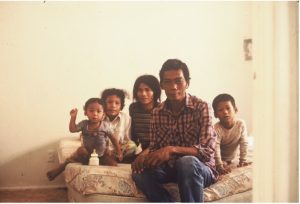
New arrivals, Carroll Street
The Cambodians would come into Dallas-Fort Worth International Airport a few families at a time, clutching their papers, benumbed and exhausted. Their journey across the world had taken them through war, genocide, and refugee camps before it ended in Dallas.
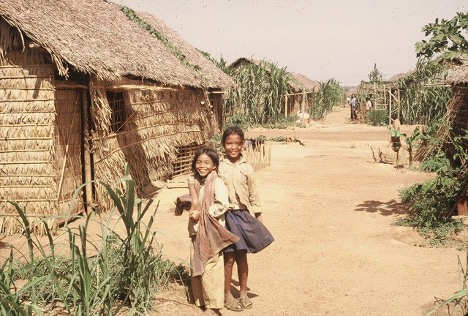
For most, the journey began around 1975 (“Year Zero”) when Cambodia fell to the Khmer Rouge and the entire population of ~7 million people was forced into brutal agricultural labor in the countryside. By 1979-80, when the regime fell, around 2 million people had been murdered or starved to death. Many of the survivors fled to Thailand where they were put into primitive refugee camps. From there the lucky ones were sent to America or France beginning in 1980.
They were met at the airport by caseworkers from refugee agencies such as the International Rescue Committee, Catholic Charities, or by church groups. They would be taken to a slum apartment furnished usually with a few mattresses, a small table, two chairs, some pots and pans, dishes and utensils. There would be a 50-pound bag of rice, a chicken, some fish sauce, and
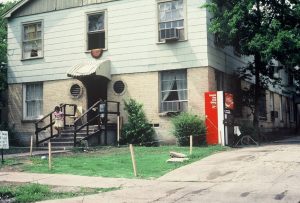
Apartment on Carroll Street
a few other staples. Welcome to America.
When sponsored by a church the circumstances were less dire as there was usually a committee of church members who would help in various ways. Most families came in expecting to go to work within a day or two of arrival. The lucky families would have someone in a job within a few weeks.
In some locales like Long Beach, California and Lowell, Massachusetts refugees were placed on welfare, food stamps, and Medicaid. In Dallas and Houston they received meager refugee assistance support for 6-12 months and then were on their own. Problems related to resource poverty were compounded by the third world rural background of many Cambodians and the myriad problems of genocide survival, grief, and PTSD. The fact that in Cambodia many of the leaders, intellectuals, businessmen, and clergy had been murdered was a problem in terms of community adaptation. Really, Cambodian refugees lived extraordinarily uncertain and stressful lives.
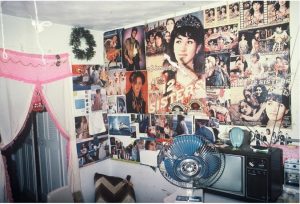
Inside apartment – family living here for several years
A few thousand Cambodians were resettled in the refugee neighborhood in Old East Dallas centered around Fitzhugh, Carroll, Bryan, Annex – an area with low rents and high vacancy rates. Apartment buildings had 20-40 mostly one-bedroom/one bath units less than 300 square feet/unit. Typical living situations would be families of 4-6 people in each apartment. In living rooms and bedrooms there would be mattresses on the floor with curtains around them if for adults; children would share mattresses, there would be a table, an altar of some kind, posters from a popular Cambodian movie. Window air-conditioning units might or might not work. They were hot in summers, cold and drafty in winter. (Placement in distressed urban areas or “hyperghettos” was the norm for Cambodian refugees across America.)
Language was an important issue among Cambodian and other refugees. Often it was children who were best able to speak English and translate for their family. This created stress within families as it placed children in a more powerful position than adults and it called upon children to be involved in adult and sometimes embarrassing or very personal matters. Few health care providers, police departments, or other official organizations had Cambodian language capabilities, so there were real problems in interactions.
War and radical
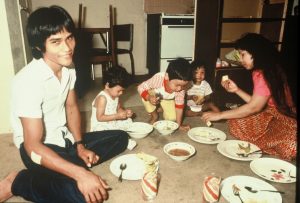
Dinner
communist rule had shattered many families. In some cases families had been recombined by the Khmer Rouge or by circumstances in the flight from Cambodia or in refugee camps. Many households were headed by widows. All of this created stress and hardship within families and within the community.
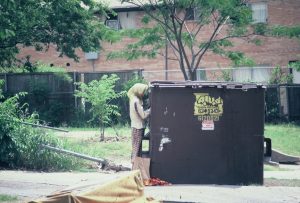
Recycling aluminum cans was always a way to make a little money
Infants and small children were cared for within families and if parents were working, children were cared for by older women. Breast-feeding was common and thanks to one dedicated volunteer, many women and infants were enrolled in WIC (Women Infants and Children nutritional program). School-age children were enrolled in area schools. One elementary school in a wealthy neighborhood was able to count Cambodian children toward their required minorities enrollment. In the early years, Cambodian children were seen by teachers as generally quiet and respectful students. There were several missionaries in the community focused on youth and two scouting groups led by volunteers. As time passed, some middle and high school students gravitated toward gang life – refugee children had hard, stressful lives, too.
Women and girls mostly wore colorful flowery sarongs with tops that were sewn by themselves or shirts from the second-hand store. Men wore checked sarongs at home and pants and shirts in public. (Within a few years of arrival community leaders, especially Christian preachers discouraged wearing sarongs as too foreign or something to be ashamed of.) Many older women chewed betelnut; men smoked cigarettes as soon as they could afford them.
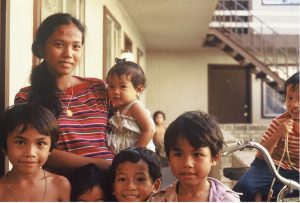
At 1604 Annex
People shopped for food at one of several Vietnamese stores on Fitzhugh or Bryan. There was a larger Vietnamese store on Capital near Carroll. Those with transportation would shop at an open-air Saturday market in West Dallas where live chickens and fresh produce could be bought. As soon as possible people who could planted gardens with lemon grass, basil, mint, bitter melons, etc. Meals were taken with families sitting on the floor.
Jobs were difficult for Cambodians to find, even for the more educated. Language barriers, transportation, cultural dissonances, ways of interacting, lack of phones, poor physical and mental health status, and other factors made finding and holding a job challenging. In all cases, pay was poor. Exploitation sometimes occurred such as people working for a few weeks, then being fired with no pay.
Although many people needed healthcare and other assistance, often all they got was tuberculosis screening. Prenatal care was difficult to obtain, family planning was non-existent, sick care was almost impossible to obtain, medications were a mystery to get and understand how to take, and few Cambodians could take off the full day necessary to receive care. Health care providers had little, if any cultural awareness or even awareness of the unique health issues among Cambodians. Volunteers stepped up to fill the gaps as best they could.
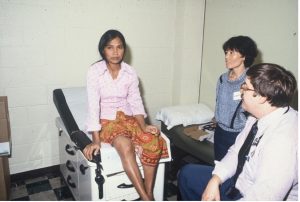
The first patient at the East Dallas Health Coalition Clinic – the clinic was started in the Fannin Elementary school nurse’s office
One of the consequences of Buddhist clergy being murdered by the Khmer Rouge was that in many respects Cambodian refugees had few spiritual resources, especially in the early years. Evangelical Christian missionaries, Cambodian and American were quick to step in with answers to fundamental questions like, “Why has this happened?” After a few years a Buddhist temple was established for worship and important ceremonies.
That’s how Leslie and I and others found them in 1981. Struggling. Desperate. And still maintaining integrity and dignity.
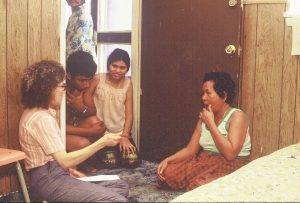
Leslie at work in her office, the floor of someone’s apartment
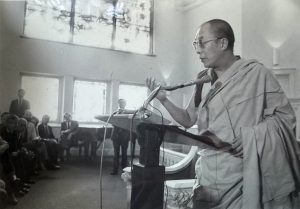 about the request and okayed it. I was not surprised at any part of these events. I think the decision went the way it did because we told him the truth about the situation in Dallas and the Dalai Lama has great empathy for refugees and is himself a refugee.