Backpacking in the Bandelier Wilderness

We were on the road again about 4:30am Monday, headed west through Fort Worth, then northwest through Wichita Falls and Amarillo; west to Tucumcari (still not much there except some low rent motels, but nicer than before); northwest into wide open New Mexico through Las Vegas with the snow-topped Sangre de Cristo Mountains off into the distance; into Santa Fe (a Wild Oats/Whole Foods right on the highway for a nice place to stop for whatever) and then north and west to Bandelier. Along the way along old Route 66, along the train tracks headed out west we saw wild turkeys, camels, pronghorn antelope, hawks …

Keep on rollin’
Just a mile to go,
Keep on rollin’, my old buddy,
You’re movin’ much too slow

Leavin’ Texas
Fourth day of July
Sun so hot, clouds so low
The eagles filled the sky.

Catch the Detroit Lightning
Out of Santa Fe
The Great Northern out of Cheyenne
From sea to shining sea

Jeff said that going to a rest home is probably about like being in prison or the Marine Corps. There’ll be people and things you don’t like, but you just gotta learn to deal with it because nobody’s getting out until they do their time – which in a rest home is usually 3-6 years before they carry you out the back.

Got into Bandelier around 5pm and went first to the ranger station to work out our route, then to Juniper Campground (drive-in campsites) where we set up our tent and grilled sausages for dinner (with salad from Wild Oats, bread from home, water). We pitched the tent without a fly, so it was a cool, open night. Up at 7am, had cereal with milk from the ice chest, broke camp fast, and drove to the ranger station to leave the car and hit the trail up Frijoles Canyon. Photo: Cliff dwellings

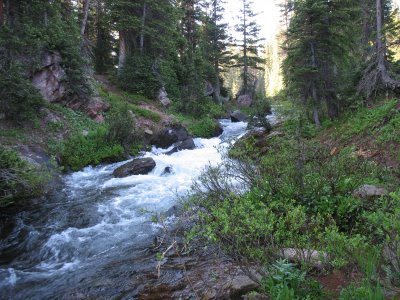
The first mile or so of the trail was paved – and took us to the Anasazi Indian (ancestors of the Pueblo Indians) cliff dwellings along and in the cliffs on the northeast side of the canyon. We spent an hour or so in the caves, structures, and ruins there and then on up the shady trail through Douglas fir and Ponderosa pine alongside and back and forth across the mountain stream running cold and clear through the canyon. The canyon walls were 200-300 feet high, with the NE side having vertical to overhanging rock and most of the SW side steep rocky scrub, though there were places with walls on both sides, and sometimes within a 100 feet of one another. There were ferns (some maidenhair), horsetails, violets, columbines, lady’s slippers, what looked like strawberries in first bloom, and other wet woodland plants all along the trail. There was one place where a spring flowed across the trail and into the stream and there was a clump of iris in full bloom in the mud beside the trail. Photo: Jeff on the trail

The walk was only slightly uphill, but we were tired and glad to get to a good campsite around 2pm in “Zone F” on the NE side of the stream (there were many good sites on the SW side of the stream) (6-7 miles). I guess we were feeling the effects of age and the 7000 foot altitude. We pitched the tent on the thick carpet of pine needles among tall Ponderosa pines at the base of the cliff. We fixed the main meal of the day by around 3pm – freezer bag homemade dehydrated chili, cheese, crackers, and water. We used a cat food can stove and denatured alcohol to cook and it worked just fine. Jeff took a nap in the tent and I walked up to the bottom of the cliff amongst the rocks and found a shady spot where I wrote for awhile, then dozed. I went back down to the campsite and we talked for awhile, had an energy bar for a snack and turned in as soon as it was dark. Photo: Stream

In the morning we had FB oatmeal with apples and pecans, and coffee. We talked about the route and decided to take an easier loop than originally planned – the new route was shorter and had less up/downhill. This decision lightened my mind quite a bit. We continued up the canyon and at the Upper Crossing headed up the Mesa del Rito. It was a good hump up switchbacks to the top of the mesa. We walked about a mile back to the SE above the canyon and stopped around 2pm (~4 miles). There were junipers and then Ponderosa pines and we found a great campsite slightly below the top of the mesa. The site was among huge Ponderosas, completely level and soft with pine needles. We pitched the tent without the fly and fixed the main meal – FB mashed potatoes, Spam, rosemary, butter, cheese, and bread. We’ve had several single serving packets of Spam around since the last trip to Asia. On the packets is written, “Just rip and tear your way to crazy tasty town”. Okey dokey. Photo: Cougar scat

Jeff took a nap and I walked to the edge of the mesa to write. I watched a hawk ride the wind high above the canyon and then the wind got bigger and bigger and the hawk was gone and I dozed, leaning against a Ponderosa with the wind blowing over me. We hung out by the tent, talking and then to sleep as soon as the sun went down.

Around midnight I awoke with rain on my face. We got the fly on in less than a minute (fortunately we’d already set rocks ready to anchor the fly). We slept well with the rain pattering on the roof of our tent like a little cave. Thanks to the decision to shorten the route, we had no need to get up at any particular time. The rain let up around 9am and we fixed FB oatmeal with dried mango and pecans, and coffee. Moments before we finished it began raining again and we laid up in the tent for another hour or so. Photo: Campsite on Mesa del Rito

As soon as the rain slacked off, we broke camp and headed down the trail at a Captain Kappleman pace (he was the C Company Commander and always set a fierce pace). It rained some, hailed (little pellets) some, and there was a little thunder – the reason for the fast pace. We were glad to get well off the mesa. By then were so close to the ranger station we decided to not pitch (a wet) camp and walked on out down the side of the canyon (where we realized how extensive the ruins are as we walked above them on the opposite side of the canyon) and back to the car (~5 miles).

It was a good trip, easy hiking, not as harsh a desert environment as Big Bend. While we were in the wilderness area we saw eight other people. We saw summer tanagers, robin red breasts (with brighter colors and sharper markings than what we usually see in Dallas), several different hawks, flickers, canyon wrens, wily old crows, vultures, and many others. We saw mule deer, squirrels, lizards, one snake, and clear blue skies, clouds, rain, hail, and rare beauty. Photo: CK cooking, 1st afternoon on the trail. Stove is inside the foil windscreen on the right.

Some lessons learned: New pack from REI and trekking poles good. Homemade dehydrated food much better (and cheaper) than bought. 5-7 miles in about 5 hours is about right for Jeff and me.

More photos are on WorldisRound

Cleaning out my office

It’s Cinco de Mayo and I’m cleaning out my office. Several people have asked if it makes me feel sad and though surely somewhere along the way I will feel sad, so far, no. I feel nostalgic, looking at photos of people whose lives and sometimes deaths have crossed mine (see Look at her face below) – and seeing reports from students on some of the wonderful work they’ve done – and cards and notes from people – and so on. Mostly I’m looking to the (unclear) future, not knowing exactly what will happen – beyond spending somewhere around 6 weeks backpacking in the Rockies this summer (Glacier, Winds, maybe Beartooths). Leslie and I are talking about Asia in the early spring. So the details are cloudy, but the direction is good.

The garden has exploded in color and fragrance. We leave the front door open in the evenings and the front of the house is perfumed with roses (Maggie, Buff Beauty, Old Blush, American Beauty, Perl d’Or, Zepherine Drouhin, Marie Pavié, New Dawn …), Confederate jasmine, iris … Photo: Standing in the front yard, looking toward the street. The arbor is covered with New Dawn (be careful walking through – lots of thorns), mid-lower part of photo is American Beauty (a true and fragrant beauty), delphinium in the garden and in the yard.

Look at her face

Tomorrow is my last day with students. There is other work to do, evaluations, clearing out my office, graduation ceremonies, etc., but tomorrow is it for a large part of my life’s work. I’m still in kind of a daze at (for me) the momentousness of it all. I don’t seem to be able to get very far with my thoughts about the past or present or future. The last time I looked at the clock last night it was 2:30am. The students had a wonderful lunch today – and included the promotoras and several of my community health friends. This evening I’m thinking about some of the people my students and I and others (especially Leslie) have been with over the years …

Pheap T. – We took care of her for several years while she died of cancer and alcohol. I remember a student kneeling, praying beside the dirty little couch Mrs. T. stayed on – it was the only time anyone really touched her that I knew of. Photo – Outreach with Cambodian refugees
Tresia B. – When we turned her over the first time 100s of little roaches scattered from beneath her great bulk. She had the most amazing candida infection I’ve ever seen on anyone without HIV. She died from cancer, followed very shortly by …
Nicholas E., the man who lived with Ms. B. He and I used to sit at the coffee table in their apartment while the students did what they were doing with Ms. B. Alison helped – like an angel.
The old Vietnamese/Chinese couple who fixed me cafe sua da every week. My friend Jay would come over and we would sit in the doorway of their little apartment in the back of 4400 San Jacinto, drinking the sweet strong coffee and watching the always happening parking lot – people walking through, children playing. When they moved to Cali they had us over for a huge lunch. We’d never done a single thing for them.
The little girl with the big nevus on her face who we got into Children’s for plastic surgery – whose mother had this tiny little store in her apartment where she sold soft drinks, cigarettes and candy to people in the neighborhood. One day the girl and her mom were getting into my truck and she said, “My mother says that man over there has a gun.” He was walking toward us and I was pulling the mom into the truck driving backwards through the apartment parking lot (1418 Annex) and over curbs. 30 minutes later the man and his partner were in a shoot-out with the police on Central Expressway.
Rith S. R. and Yan S. – Yan was about 4’8″ tall – Leslie got her a job at a hospital – she looked so great standing next to her 6’6″ supervisor. Later their lives were unbearably sad. We still talk every Christmas.
Tep K.S. – who Leslie did so much for as he died – when I took him to the hospital the last time – where he died in the hallway, I asked him if he wanted a stick of gum and he just shook his head. His wife and daughter sometimes bring us curry, still.
The man who died in his sleep and was kept for autopsy while his children went to another satte. His daughter would sometimes run naked and baying through the streets. Leslie was always the one taking care of her. Leslie was the only person at his funeral – you could do a lot worse than that!
The Vietnamese woman who had been a prostitute long ago and the student with her at Parkland going head to head with a doctor who wanted the woman to sign an (uninformed) consent for cancer treatment. The doctor called me to report the student and I was saying, “Uh-huh.”
The girl the students and I sprang from her apartment prison – the students distracting the mother-in-law while the 16 year old girl tossed her possessions in 2 black garbage bags out of the 2nd story apartment window to me standing below. Then the students and the girl walked out past the m-i-l.
The Cambodian family that fixed a wonderful lunch for the students and I. Such a nice lady.
Lay Rith, beautiful beyond measure, taking us in as we took her in. I visited her and her husband in Long Beach – gunshots in the background, one of her boys showing me his pogs. Her beautiful daughter Re already a gangster. Photo: In the waiting room
The two teen girls the students found living together in an apartment with no furniture – just a couple of blankets on the floor, on the run from their molesting “father.” One of the girls ended up in prison, the other still comes in to the clinic.
The two people we made suicide contracts with last week.
The 1000s of people who have a place to go for healthcare, thanks to Bobbie, Leslie, me, others. And the 1000s who were cared for at the East Dallas Health Coalition, thanks to Syl, Pauline, me, others.
The boys who were being molested and told Alison’s friend, Sandy. They called on Leslie, who made everything else happen and the guy went to prison for life and Leslie and Alison were there when he was sentenced – gonna follow your casket down in the pale afternoon.
The girls Martin and I were talking to one day and the next day their father called me, crying – one had drowned and the other barely lived. Martin and his colleagues did the funeral.
The woman who was a terminal alcoholic who said to me one day in her cracked, quavering voice, “Help me mister.” I said, “____, there’s nothing I can do to help you if you won’t stop drinking.” She died that night – there was blood on the walls outside her apartment. The minister didn’t show at her funeral, so two Mormon missionaries and I did the service.
Guadalupe S., taken care of by everyone. She lived in about the most run-down house in East Dallas. Leslie was there one morning and her husband was sitting beside the house having a beer and jalepeño taco (nothing but jalepeño on that taco) for breakfast.
The Dalai Lama was in Dallas and we managed to get him to Grace Church to meet with the Cambodians. This was about 1983. After his homily there were about 30 people around him and I was standing on the periphery. He had never seen me before and there was nobody there to tell him what I was doing. He reached through the people around him and took my hands like in a prayer, giving me a blessing, saying, “Keep doing this work.” Photo: Something beautiful for God
The Mexican woman with rheumatoid arthritis – Leslie went with her to the doctor who said, he didn’t think she was having much pain. Leslie said look at her face – tears running down … Look at Her Face.
The young Muslim woman dying from breast cancer, taken care of by my students Megan and Stephanie (who taught us all about spiritual care), by Leslie, and by Diane – not to mention a Jewish oncologist and the Jewish dentist Leslie found who did the work free, then a Muslim women’s association stepped in and paid for some of the dental work. Meanwhile her brother descended into complete insanity and the psychiatrist said, “I don’t understand why you people are calling me.”

Each one of these little stories is a lot longer. It just goes on and on and on.

A Dream

I dreamed last night that Ron C and I drove to a place near our home city where there was a village from Laos. It was set up in kind of an inverted U (ת); Ron parked at the bottom left corner and I immediately walked over to the right branch and started walking slightly uphill up a dirt path past little hooches (some Lao, some made of salvaged stuff from the US; most on stilts). There were Cambodians all around, some sitting in the doorways and I knew most of them from back in 1981-85. They were people who never made it in the US, but now they were happy and I was happy to see them. As I walked along we were speaking back and forth – “Oh, hey, I’m so happy to see you.” (I’m smiling writing this.) A young man was walking with me and when we got to the top (bottom of the U), we followed the path to the left and went underground. There were several large turtle heads sticking out of the wall like they were roof decorations but down low and there was fine detail everywhere, all dark and smoky looking and I was asking how all this could be here and the young man told me two women had gone to Laos and bought an entire village and brought it to the US. We went on to the last leg of the U and walking downhill came to kind of an infirmary with blankets over the two doors and I was thinking, maybe this a place for me. The door on the left was L&D and there was someone in labor in there. I asked the young man to ask if we could go in and he said something and an irritated looking midwife came out and said in Chinese, “Both of you go away.” We moved on and along the way, I told the young man I’d forgotten his name and asked what it is. He told me, but now I’ve forgotten it. He showed me how his eyes were all wrong, which I’d already noticed, but now looked closely at them, one rolling up and both kind of inflamed around the margins of his lids. When we came to the end of the leg, there was a building standing a little separate from the others. The young man told me it was a kind of church, and when I looked closely at it there were Kwan Yins and Virgin Marys painted kind of randomly on the outside walls and I realized that they are the same thing (Mercy) and always have been and I wondered how I could not have noticed that before. Ron was there and so was Leslie and we were talking about what an amazing place this is and Leslie was saying that she’d worked hard to make it happen and I remembered that she had gone up against some government entity to help the women bring it here. That’s all I remember.

Weeks and days passing

Writing the I’m Retiring entry put a hold on my writing. Since then …

A couple of weeks ago I spent several days working in the garden and yard. In the back garden, the iris (bought at an Iris Society sale) are blooming, Zepherine Drouhin and Lady Banks are blooming, and some of the herbs are doing well (oregano, sage, germander, lemon grass, mint, rosemary, and savory). I had let the garden go last summer while we were in Asia, but the good soil preparation years ago continues to pay off.

In the front cottage garden, roses are blooming (Old Blush, Maggie, Zepherine Drouhin, Katy Road Pink, Marie Pavié, Hermosa, and the even more wonderful Cécile Brünner), iris are magnificent (white, purple, yellow, and variations), delphinium are starting up (white, blue, pink), oxalis are carpeting in pink …

A few nights ago I awoke thinking about what it will mean to not be doing mercy and justice. For many years these have been huge part of my identity, my self – not my thoughts or beliefs, but what I do, who I be – and I’m setting it aside.

As the weeks come and go and retirement nears, I’m in a suspended state. It all seems unreal, unclear. Yet my eyes, my mind are clearer. Photo: On the right, Leslie waiting for the bus in Nepal, 1978 and on the left, Leslie on the bus in Burma, 2007. Aren’t these the greatest photos!

You are the best of all my days


I’m unable to say with clarity what I’ll do, except that I’ll be in the high mountains, first with David in July and later with Jeff and (maybe) Somsai in August and September. But that only says where I’ll be and who else will be there, not how I’ll be. Oh sure, I’ll be tired, dirty, sore, sunburned, hungry, and all that other good stuff. But how I’ll really be is …
Standing alone on a mountain-top,
Looking out at the Great Divide,
My soul rising, rising, rising,
Flying, complete.

I wrote in the last entry that after Vietnam I was committed to not wasting the time of my life. I have not.

This weekend the G5 men’s Bible study group went to Jim C’s lake house. Like last year it was a good time – good to be in Charlie and Alayne’s old house (now Jim and Nell’s); good to relax with Jim, Mike, Chuck, Ken, Chris, Bryce, Rick, and Dave; good to sit on the screened porch and watch the lake, Mike fishing, the birds; good to sleep out under the stars; good to be.

I’m retiring

.
Well, I did it – I sent the letter and will retire at the end of spring 2008. Less than 2 months and one more clinical group to go. It’s time. My work has been a huge and fulfilling part of my life these past 30+ years. I’ve accomplished more than what I set out to do – hospice, refugee work, teaching, community clinics, 3 books and >100 articles and chapters, 1000+ students, and many 1000s of patients. For more than 30 years I’ve put others first much of the time – not now and then or philosophically or whatever, but in hard reality. My goals for the coming years can be summarized in the words of John Muir: “The mountains are calling and I must go.” Now, at least for the next ~9 months, I am laying it down. Glacier, the Wind Rivers, and Southeast Asia are next. Then the John Muir Trail. Below is a summary of my career. It’s long, so you might just want to let it go with this first paragraph above. Photo: At the DMZ – it was about to get a lot worse

Career, part 1

5-6 years after Vietnam I had a store on Sears Street off lower Greenville. It was called the New Store and I and my partners David N. and Jeff W. made and sold waterbed frames, shelves, walls, tables and the like. One day a customer who looked familiar and I were talking and we realized we knew one another in high school. She had dated one of the Catholic guys I hung out with (and who later was badly wounded in Vietnam). She had become a nurse and as we talked I realized that working as a nurse was something I could do that for me would not be a waste of time. (After Vietnam I was completely committed to never wasting the time of my life.)

To get into nursing school I had to take about a year of prerequisites such as organic and inorganic chemistry, anatomy, physiology, micro, and so on. To pull up my abysmal GPA I had to make close to all As. Taking these course was the first time in my life I applied myself in school. I made all As and was admitted to Baylor School of Nursing. The next two years was good. The courses and clinicals were mostly good and to my surprise, my fellow students were among the first people I could relate to after my 13 months of combat in Vietnam. The young evangelical Baptists and the old profane Marine found common ground. Except for the religion course (from the Baptist perspective), I made all As – I mean, what chance did have in that company – I was probably lucky to make a B in that course. I graduated magna cum laude in 1975.

I’ll stop here and express my deep appreciation to Leslie – I’d be so much less without her. Leslie’s love and loyalty have sustained me though some tough times and it’s not been easy for her. She’s stood tall beside me for many years through the good times and the bad. This sounds almost flat – for once I don’t have the words to express all that she has done and my love and gratitude to this woman who changed my life – all for the better. More later.

After I graduated, I worked at the VNA for a year — first as staff, then supervisor. In 1976 we went to Austin for me to go to graduate school. Leslie got a good job in the DHS state office – good in the sense of not having to contend with destructive politics or personalities. I got a M.S. in psychiatric nursing. There were some interesting times working in Austin State Hospital with people who were chronically mentally ill. We lived on 43rd Street and were very happy there. As I think about it, we’ve been happy just about everywhere we’ve ever been.

We wanted to go back to Dallas, but I was having difficulty finding a job in Dallas that I felt was appropriate for my master’s degree status. Then I went to a Transitions Retreat held by Elisabeth Kübler-Ross in San Antonio. The way these retreats worked was they had about 75 people (1/3 terminally ill, 1/3 bereaved, and 1/3 caregivers like myself) in a room to share our lives and selves with the others. We cut quickly through the crap – like, “I’m here because I want to learn how to take better care of people who are dying” – when someone said, “I’m here because I have the problem of judging people.” It turned out that we were all there because of our pain, aloneness, judgments, and so on – we were all there to be healed. Except for meals and bathroom we were in that room from 8 am until 1 or 2 am the next morning. Truth was told and I was humbled. I went back to work as a staff nurse at the VNA because, of course, all I ever really wanted to do was take care of patients. Photo: Tillie, a hospice patient

In early 1978, some friends (Ruby Carter, Tim White, and Johnnie Turner) and I came up with a plan to make note cards with all our names and phone numbers on the cards. We gave the cards to our patients who were dying so that they would always have someone to call when things went bad (no pagers or cell phones in those days). We also started a study group to look at what other people were doing in caring for people with terminal illness. In April the executive director of the VNA called me out of the field to begin planning a program for people with terminal disease.

At the same time I began planning, Jean Saunders asked me to see a friend of hers who was dying. The woman was Jan Viola and for the next several months, along with her amazing mother, Jean Mitchell, I took care of her. Jan had breast cancer with widespread metastases (brain, spine, and eventually lungs and liver). Before I met her she developed spinal cord compression and lost the function of her legs, bowel, and bladder. Her Mom and I went all the way through the journey with Jan and we were with her when she died. Jan was a tough customer and it was a great privilege to care for her.

Meanwhile the program grew from the VNA Terminal Care Program and before I left, it became the VNA Home Hospice Program. During this time it became the largest and one of the best hospice programs in the United States. With two other people I wrote a grant proposal which resulted in the program becoming one of 26 hospice demonstration sites across the U.S. The start-up was a consuming two years. We were blazing a trail and it was a good trail that many followed. Then I resigned as director to work as a hospice clinical specialist. My replacement as director was intolerable to me, so I left. The creation of this hospice – the service given to patients and the influence on the care of patients of other agencies and hospitals – is something I am very proud of.

I went to work teaching community health at TWU. Shortly after I started there (1981) Leslie and I got involved in refugee work. We had contacted some agencies in prior years, but nobody wanted individual volunteers. One day I got a call from Kevin M., an infectious diseases specialist at UTSW. He wanted to know if I wanted to go to a house in Old East Dallas and put in some PPDs for some newly arrived Cambodians. Leslie came too, and we were quickly caught up with Cambodians. It’s difficult to describe what we’ve done. People tend to seize on the most concrete thing, such as a clinic. But it was much more than that. We gave a lot of help to a lot of different people: individuals, families, and community. It was incredible working like this with Leslie – she is a great person in the same sense as Dan F. (all about mercy). We consciously tried to embody welcome to as many people in as many ways as possible. Photo: Francine, a hospice patient

The following was written during that time and I’m leaving it as it was written: For us personally it’s the first time we’ve worked together like this. For the first time in all that I’ve written, I am at a loss for words. It’s been about three years of very intense work; long hours and life and death; steady. Then for about two years, less of the personal work and more organizing, meetings, and politics, at which I am not very good. Leslie and I worked together very well and very productively. The Khmer have been amazing. In some ways they are like people anywhere, and in other ways there is nobody like them.

What stands out for me is their tremendous strength along with their grace and beauty. One thing that sets Cambodians apart is their having been through a holocaust (which of course is far more than just the killing). We learned a lot and for both of us I think it’s the most we’ve ever done or experienced. We’ve spent a lot of time in the apartments on Carroll, San Jacinto, Fitzhugh, Bryan, Annex, Sycamore and Live Oak working it out, figuring it out and filling it out (a million government, etc. forms). We also spent time at Parkland, Children’s and various clinics wheeling and dealing, operating at top speed in some very intense relationships. In 1982/83 we visited refugee camps at Khao-I-Dang on the Thai-Cambodian border, and Aranyaprathet, which is closer to Bangkok.

Community development wise, we were directly responsible for the East Dallas Health Coalition, involvement of the Dallas Police with refugees, the NCJW Khmer Community Development Project, the TWU Project, raising a fair amount of money and providing most of the community education, and so on. As I write this I am aware of how much was done and how lucky we are. But it was what we did in the apartments with individuals and families that will live on in us.

Teaching at TWU was good, in part because I met my mentors, Bets A. and Judy M. there and partly because I was doing the refugee work. I was able to put the teaching and refugee work together and thus amplified both.

Career, part 2

.

The second day of taking students into the refugee community I was sitting on the back of my blue Toyota pick-up truck behind some apartments when a student came running up, “Mr. Kemp, a lady is having a baby in those apartments!” By the time we got there the other student had caught the baby and everything was under control. We called for an ambulance and they came and took the woman and baby to Parkland. A while later I saw the ambulance was back. We went over to see what they were doing and learned that the hospital had sent them back to get the placenta so they could count the lobes. But in the meantime another woman had put it in a paper sack and into the dumpster and when the EMT reached into the dumpster to take it out the bottom of the sack broke open and the placenta slithered out and down deep into the dumpster. In Texas. In the first week of September. In a refugee neighborhood. Have a good time in the dumpster. Photo: Student with Neth Nguon

Our base of operations was mostly Lay Rith’s and Chneang Roeun’s apartment on Fitzhugh. Cozy, full of children, the transcendental Lay Rith, and the wonderful grandmother – a perfect community health operation. Leslie and I worked together 7 days a week, from family to family. What a job. In other accounts I’ve written more about Leslie. The other major player in all this was Ron C., a police officer who became (and remains) a good friend.

Things were going well at TWU until I wrote a grant proposal for some HIV outreach. Somehow that put me in the line of fire between the dean and associate dean and I was told to resign. That was a hard time, but, you know, time passes.

I started teaching at Baylor in 1989. Though I took students to Terrell State Hospital a few semesters, I was able to transfer the refugee work over to Baylor. Here is something from a website:

In our earliest work in East Dallas (1981-86) we worked only with Cambodian refugees because they presented with the greatest health needs and problems of any population in the area. At that time we were working door-to-door in the community and initially had no physician services. Students conducted in in-depth community assessment and that document was used to obtain agreement from Temple Emanu-el for them to work with us to develop medical services. That partnership led to the East Dallas Health Coalition, which later became the East Dallas Health Center, Dallas’ first community-oriented primary care (COPC) center.

Leaving the medical care to medical people, we continued working in the streets. In 1991 we decided to adopt the district health model and shift our focus to the community as a whole rather than a specific population within the community. We took responsibility for providing health care to a culturally diverse (primarily Asian refugee and Mexican immigrant) inner-city low-income community with significant needs/problems. Rather than begin with another lengthy formal assessment (Is it really necessary to again show that this or any other such community has unmet needs?), we began working on one street to assist people in the community to obtain health care and social services. We went door-to-door and every time we found a person with an unmet health or related need, we stopped and figured out how to meet the need. Through the process of assisting people with the problems they felt were most pressing, we were able to develop a trusting and professional relationship with the community; identify needs and problems at all levels of care/prevention/promotion; develop a meaningful understanding of available community services, and become a part of the community of solution.

ooo

In the early 1990s I began work on the book I had wanted to write since my days in hospice – a practical guide to caring for people with terminal illness. I went with Lippincott as publisher because they had also published Bernard Fall’s work (Hell in a Very Small Place, Street Without Joy, etc.). I thought the best part of the book was a series of tables and text that charted the natural history/metastatic spread of the 18 most lethal cancers. The tables spelled out what to look for as the diseases advanced so that problems could be identified early rather than late. The book, Terminal Illness was published in 1995 and the second edition in 1999.

In the mid-1990s Parkland agreed to send a physician to work with us out of the East Dallas Police storefront facility. We thus had medical services, refugee screening through the Dallas County Health Department, and outreach through Baylor students. Leslie and I were back in business together with her doing the social work and clinic management. We began working with Church Health Ministries (CHM) in the late 1990s and through that relationship, added additional medical services. We moved to a small community church in 1999 and in the spring of 2000 separated from CHM. Photo: Me, Khan Soeurt, Kara (student), and Lance at the community garden

Community Care moved to Emanuel Lutheran Church for a few months. We were in the church house next door to the church on one side and a crack house on the other. They had good-eyes in upstairs apartments across the street – a scene. Estevan G. was our doctor, a wonderful ER pediatrician and good man. One thing he taught me was how to start with a room full of patients and work steady through them.

One day I was at the clinic in Emanuel’s church house, maybe an hour before I was to leave to go to New York to get an award, kind of a crowning one, when the pastor came in to tell me they were severing our relationship. “The elders feel that our relationship is with Church Health Ministries, not this clinic, and have asked me tell you that we can no longer … blah, blah, blah” – it was surreal, unreal, devastating – the destruction of what we had worked so hard to do. It was not really about the church and was not instigated by that church – it was about power and politics, revenge. Heavy stuff. The award was sand in my mouth.

I remember what this one guy – a famous guy, perceived by many to be a spiritual leader and I guess in his own way, maybe he is – said to me as he cut us loose from his so-called faith-based ministry, “I’m a pragmatist,” he said. I thought, “Yeah, that’s exactly what you are.” I think we should be careful about what we link to “I am.”

I went to several places looking for a home for the clinic and we entered a partnership with Agape in the fall of 2000. I remember when we went over to Agape. Dale said, “I’ve suggested several times that you come over here.” I said, “I believe you – I never heard it or I just wasn’t ready.” I remember we had all our medicine in 2-3 drawers of the big brown filing cabinet and when I told Bobbie (the medical director) that we’d keep ours in there she said, “no, just put it in with ours.” They had a 100 times more than we, so it was an extraordinarily generous thing for her to say. As he had done several times before, Martin H. helped move the clinic. He’s been a rock through the years! As he says, “Grace falls on the just and the unjust,” hence the name, Common Grace Ministries. Once when Martin and I were moving some very heavy something I felt this pop in my lower abdomen. Uh oh, another hernia (see how nice I talk these days).

When we moved into Agape I felt like we’d come home.

Teaching at Baylor, like any other job or aspect of life has its good times and its bad times. The best part is that the university has come to understand and support the ways in which what we are doing is consistent with Christian action. The worst part is the judgmental narrow-mindedness of some people there. Photo: Leslie, Maria (with Luvia in lap), Roxanne, and Lupe in the waiting room at Agape

I know many people and to a greater extent that anyone I know in Texas or anywhere else, I have been committed to students as (potentially) essential parts of the community of solution. I have integrated my teaching and my community care and have expected great things from my students. And through their work, great things have happened: the East Dallas Health Center, 1,000s of patients, and good work with countless people. Here is a little something from 1995:

Strange People: In the course of outreach, one of the students made several visits to an apartment where a 60-something year old woman lived with a younger man and woman. The younger woman was very seclusive and every time we were there she had blood in her mouth (but no other evidence of trauma), and would not let us close enough to determine what the problem was. In conversations with the older woman we learned that the man (call him Jimmy) was “helping” a 10 year old girl who lived nearby. Over several weeks the story came out that the girl had a bad home life. Her mother lived with two men and was having sex with both. The girl was afraid of one of the men and so spent as much time as she could with Jimmy. She bathed at his apartment and at least once a week she spent the night with Jimmy, sleeping with him on a fold-out couch. According to the older woman, he and the girl liked to wrestle. Needless to say, when the story came out we took quick action. I remember the student on this case saying in a very serious way, “Mr. Kemp, I think there may be a problem here.” We talked with a detective of my acquaintance and he went after Jimmy and brought Child Protective Services in on the case. I don’t know the final outcome, except that the girl was removed from her mother’s home and Jimmy was gone, where I don’t know.

Career, part 3

.
One of my partners in refugee work, Lance R. and I had written a print and internet guide to cross-cultural care (the state helped with our efforts). We used that as the basis for a book proposal and in 2004 our book, Refugee and Immigrant Health was published by Cambridge University Press. Again, a practical guide to providing care – in this case, to people from other cultures. Even before that book was out I began working with Tao S. and Carrie K. on a book on infectious diseases of refugees and immigrants. Tao (a pediatrician) and I met through our work with refugees and Carrie (a dermatologist) was a volunteer at Agape. Infectious and Tropical Diseases was published by Elsevier Science in 2006. A distinguishing characteristic of this book is the way it cross-references diseases, symptoms, and geographic areas to help clinicians generate a minimum of differential diagnoses. It also is cargo pocket size, so can be carried into primitive areas. Writing these two books so close together – along with working and volunteering – was very tiring to me. Photo: Vatos in the clinic

ooo

A little more on Leslie: Who fights harder for humanity than Leslie? I’m not talking about abstract stuff – feelings and beliefs and so on, nor am I talking about the occasional kindness or being a usually nice person (though she is that). Leslie’s battles are real battles – big battles – for real people and there have been many. I’ll name a few, but far from all: Florence Jessie, Sang Van and her family, Lay Rith and her whole huge family, Yann Sorn, Yuon, Amalia Garcia, the woman with rheumatoid arthritis, Maria de la Cruz, James Smith, the Vietnamese man with schizophrenia, Cesar, the Honduran man with typhus, Clarence W. … And how many 100s of thousands of dollars in medical bills has she gotten forgiven? How many people has she gotten a same day appointment at wherever? I wrote on my website something like, “What is it like to be married to a real miracle-worker?” Well, the answer is that it usually is grand – especially when we’re working together. Of course I don’t think of Leslie all the time as a miracle worker. Sometimes I’m irritated, sometimes upset – but in reality, most of the time feeling happy and grateful. And always loved and loving (except when irritated).

Here is what I wrote about Leslie on the website in about 2004: What does it mean to be married to someone who really does do miracles? I can tell you. We started when we were 16 and here we are today, 45 years later. This from the dedication to my book on palliative care: I lay dreaming that I was in an outdoor marketplace, watching a group of musicians set up to play. One by one they began to tune, softly. Then in a soft clear voice, a woman sang the words, “Who knows … where the time goes …” and at that moment I awoke and said, “To Leslie.” A true vision. Our life of love and growth. Photo: Leslie in her natural habitat

Leslie had a dream in which she had 20 seconds to say who she is: “wife, mother, daughter, spent my life trying to help other people.”

I went back to school and in 2000 was certified as a family nurse practitioner. I continued teaching community health, and once again, integrated my work with teaching. Teaching and practicing at the Agape Clinic has been a wonderful and rewarding phase of my career. Leslie and I were working together again, and together, we took Agape from a Saturday medical clinic to a Wednesday through Saturday operation with these services …

Agape: Overview of Current Services (2006)

There are a number of free clinics doing wonderful work in the Dallas area. What makes Agape unique (locally and nationally) is the integration of comprehensive services in a medically underserved community, at a very low cost.

Primary Medical Care
The heart of all Agape services (and the means by which patients and community become involved in preventive and other health-oriented services) is primary care for people who are sick (5620 patients treated in 2003). Care includes medications, the average retail cost of which is $45.00/patient. Services are delivered by volunteer physicians, nurse practitioners, and students from Baylor, UT Southwestern, and other schools. Health problems treated at Agape include acute illnesses such as pharyngitis, urinary tract infections, and common skin disorders. Chronic health problems treated at Agape include asthma, hypertension, and diabetes. In addition to treating the more common primary care problems we provide specialty care, including pediatrics, dermatology, psychiatry, and women’s health.

Immunizations
Agape is the only site in Dallas providing immunizations on Saturdays year-round. This matters – a lot – because Texas ranks 46th in national immunization rates and Dallas is ranked even lower than Texas as a whole. Immunizations were in place when we started. Photo: Patients waiting in the hall

Community Health
In 2005 Agape has held five mammogram and other (hypertension, diabetes, asthma, etc.) screening events and is scheduled for a childhood vaccination and screening event. Screening is coupled with health teaching and all patients with positive findings receive follow-up. Through Agape’s partner, Baylor School of Nursing, weekly health-related classes are provided for parents at Zaragoza Elementary School (three blocks from Agape), as well as health classes for Zaragoza students. Baylor students also follow-up on complex patients and provide outreach to more isolated patients. Community partners such as Concilio Dallas offer weekly classes on diabetic self care and how to access CHIP and Medicaid.
Social Services
The health problems of many of Agape’s patients are worsened or complicated by a variety of other issues. From teaching people how to use private insurance to assisting people into the healthcare system, patient advocacy and assistance are key aspects of care at Agape.

Professional Education
Agape is a training/clinical and service-learning site for students from Baylor, University of Texas at Arlington, Texas Women’s University, University of Texas Southwestern Medical School, Dallas Theological Seminary, and other institutions.

Spiritual Care
Spiritual or partially spiritual crises identified and treated at Agape include family violence, poverty, injustice, isolation and a host of other chronic stressors. Through Agape’s partner, Creations of Faith, patients find a safe place for fellowship, prayer, Bible study, and therapy. In addition to care provided through Creations, Agape staff and volunteers pray with patients and give other spiritual care.

Community Development
The recent grant awarded by the Dallas Women’s Foundation brings to fruition ongoing work at Agape to advance the health of the community through community empowerment. Agape has a history of recruiting volunteers from the community served by the clinic (the community served thus becomes the community of solution). The Women’s Foundation grant allows us to train promotoras salud (lay health promoters) from the community to teach and assist patients in the clinic and the community.

Community Partners
Providing comprehensive care such as outlined above requires extraordinary cooperation among different organizations. Agape approaches relationships with other organizations from a working perspective (vs. endless meetings, networking, dialoging, and the like). Community partners include:
– The community itself … rest of list deleted

ooo

So that’s it job-wise for me. Leaving the patients, students, Agape, and Baylor behind and looking to the Winds, Glacier, John Muir Trail, Asia. Life has been much richer than what I wrote above, but this was about my career and it has been a good and rewarding one. Photo: Sunrise, 1/1/2008, Big Bend

Working in the garden

Thursday and Friday I worked in the yard and garden – hired two men to haul and chop and cut, etc. Except for mowing, watering and the like, I’d let things go since last summer when we were in Asia. The yard and garden have been okay, just a little overgrown – except the back garden has been seriously neglected.

So after a great hike in Big Bend and a day of rest, I wanted to work outside. As retirement nears, my energy is picking up and I’m relaxing some.

After two long days, everything looks great, especially the back garden, which shows again the importance of good soil preparation. I worked very hard on the soil when I put the garden (back) in 7 or 8 years ago, and it shows. The roses seem to be fine. Iris are growing strong. Some herbs are doing well – oregano, sage, germander (whatever that is), mint, rosemary [native is by far the best], lemon grass, and something wonderfully fragrant, but I don’t know what it is. Some herbs have disappeared. Garlic is growing strong and lambs ears okay. In front the Texas Mountain Laurel is blooming prodigiously, purple and sweet.