In 1966 I was in a special landing force (SLF) on the USS Vancouver, a “landing platform dock“ ship on the way to Vietnam. The ship had a cavernous bay (the dock) with the entire stern being giant doors that opened out into the water. LVTs (landing vehicles tracked) were parked inside and when ready for a landing could drive down a ramp into the ocean and then to shore. There were around 500 Marines in our unit and I’m guessing there were 30-40 LVTs inside the bay. When the LVTs were starting up it was a huge roar and smoke
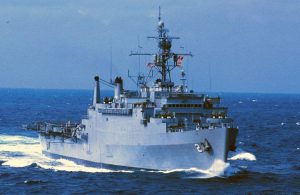
USS Vancouver
everywhere inside the bay and we were lining up to climb inside ready to go into the water and to the beachhead. Topside there was a landing platform from which several helicopters could take off or land at the same time.
After an uneventful voyage from San Diego to Pearl Harbor and on to the Philippine Islands we docked at the Navy Base Subic Bay on Luzon. I think we were there for about a week the first time we were there and after a few weeks in Vietnam we went back to Subic for an unexpected 10 days. Most nights we went on liberty from the ship to the base and from there into the town of Olongapo, or at least to Magsaysay Street, the one street in Olongapo that wasn’t off-limits to Marines
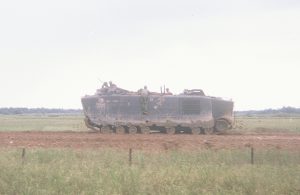
LVT. You can see a Marine hanging off the side and a driver up-front
and sailors. The street was 8-10 blocks long and was mostly bars, cafes, hour hotels, and the like.
Somewhere in there we made a practice landing on the island of Mindoro. When we hit the beach there were islanders selling orange sodas and good, heavy knives that were better than machetes for cutting your way through jungle and brush. Some of us traded ammunition for the knives. We practiced tactical movement in the jungle on the mountains in the rain. It was challenging, but not as challenging as combat.
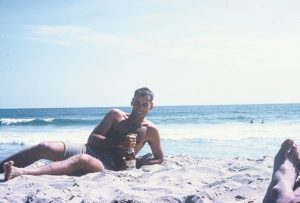
Liberty on a beach in the Philippines or Vietnam.
At the gangway from the ship there would be a Marine and a sailor who would look you over to be sure you were squared away enough to leave the ship. At the time we were required to wear tropical khaki uniforms ashore instead of utilities (like “fatigues”). We were there during monsoon, so it wasn’t easy to keep clean uniforms. When it was raining we would wear a raincoat with trousers clean and pressed from the knee down; everything else would be wrinkled and even muddy or moldy. But that was good enough to get us off the ship. We would ride from ship to shore in open landing craft, dock at the base, and then head either to the Enlisted Men’s Club for okay food at a good price or go straight on into Olongapo.
The base had an exit gate that opened onto a bridge over a very polluted river where Filipino boys swam and shouted for coins. When you’d toss coins into the water they would dive for them. Just past the bridge the party for doomed youth began. Bars were usually segregated according to service, interests, or race – some were for sailors and some for Marines; some for country music and some for rock and roll; and some were for white guys and some for black guys. Going to the wrong bar could end up in a fight, but that could lead to arrest by the Shore Patrol and a night in the brig and no more liberty so actually everyone was pretty well-behaved for drunken Marines and sailors. Most bars had bar-girls or prostitutes who could be taken out to a hotel after paying the mama-san, the older woman who managed the girls. Payment for sex was separate and between the girl and her customer. Most bars had a sign demanding that guns be checked.
The only time I went off Magsaysay Street was when some of us took a jeepney to a brothel in another part of town. Part way through the party there was a raid by the Shore Patrol and we had to run for it. As we ran through the gate to the brothel one of the guys hit his head on an iron overhead – Bong! – and was staggering around confused and had to be pulled into the escape jeepney for a wild ride back to the legal part of town.
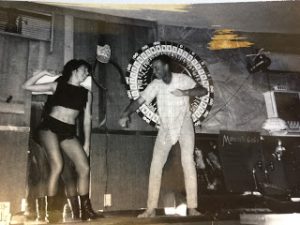
Photo in a bar in Tijuana, but it captures the vibe
I met a sweet-natured woman named Delia. We spent time in the bar where she worked, in cafes, and in a hotel. I remember once she coughed and spit it out on the floor of the bar, but I didn’t care. It was an intense time, especially the second time we were at Subic, since we had already spent a few weeks in VN, had been blooded, and so really knew what the score was. The “score” was that this was very serious business and some of us would be killed.

At the DMZ where we ended up
I ran out of money and had to make some to keep going into Olongapo. One of the guys in my company had already seen enough combat for his taste and was trying to avoid going back in. He and I worked out a deal for him to pay me to break his trigger finger. He laid his finger on a step on a companionway (like a ladder) and I hit it with an iron bar. It didn’t hurt as much as he expected and he said something like, “You didn’t do it!” and I said, “Look at it.” He did and he saw that the finger was going sideways and bleeding. I got my money and he got out of going back to VN. I recall that a few weeks later after we’d taken some serious casualties he pretended to try to get on a helicopter going from the ship to the field and was restrained by someone – phony drama. I’m glad I did it: we got rid of a quitter and I went to town. My guess is when he got out of the Corps he presented himself as a badass combat veteran haunted by the war.
For awhile my ambition was to own a bar in Olongapo or Tijuana or someplace like that. There would be prostitutes working there (but no cribs) and I would have my office on a balcony overlooking the blue-lit bar and I would sit up there drinking gin and tonics with my girlfriend.
———————————-